
Angled Foregrips, AR-10 Parts, AR-15 Accessories, AR-15 Basics, AR-15 Parts, Vertical Foregrips
How to Choose the Right M-LOK Foregrip for Your Shooting Style
May
Table of contents
Choosing a foregrip sounds simple until you are standing in front of a wall of options with no clear way to separate what works from what just looks good on someone else’s build. M-LOK has become the dominant rail standard for a reason. It is slim, secure, and compatible with nearly every modern handguard on the market. But the attachment system is only half the decision. The real question is what type of foregrip belongs on your rifle, and whether you need one at all.
This guide breaks down the three main categories: vertical foregrips, angled foregrips, and handstops. It helps you match the right option to your shooting style, build goals, and legal requirements.

TL;DR- Too Long Didn’t Read
Choosing the right M-LOK foregrip can significantly enhance your shooting experience, but it requires understanding your specific needs and shooting style. This blog provides insights on selecting the appropriate foregrip type—vertical, angled, or handstop—based on various use cases.
- Vertical foregrips offer maximum control and leverage, suitable for heavy builds and barricade shooting but may affect speed and have legal implications.
- Angled foregrips facilitate speed, comfort, and natural wrist alignment, ideal for competition and tactical environments.
- Handstops provide minimalist control, maintaining a snag-free profile without affecting wrist movement, suitable for tight spaces.
- Legal considerations are crucial; verify local laws, particularly when configuring AR-15 as a pistol.
- Test your setup to identify missing elements; a foregrip should solve a specific problem like fatigue or inconsistent hand placement.
Do You Actually Need a Foregrip?
Before adding hardware, be honest about what your current setup is missing. Many modern AR-15s with free-float handguards shoot fast and accurately with nothing more than a C-clamp or thumb-over-bore grip directly on the rail. The AR platform’s straight-back recoil impulse in 5.56 is mild enough that refined technique often outperforms added hardware.
A clean rail gives you complete freedom to shift hand position across different shooting positions and stages. Any foregrip locks you into a fixed spot, which creates new problems if placement is off.
Reasons to skip a foregrip entirely include prioritizing a lightweight, snag-free setup for home defense in tight spaces, competition stages with heavy movement, or hunting in dense terrain. If you are already shooting consistent splits with good control, save the weight and the money.
A foregrip earns its place when fatigue becomes a factor during extended training or matches, when you need a repeatable index point under stress, or when your build involves a heavier barrel, suppressor, or accessory package that shifts the balance forward. Test your rifle as-is first. If you notice wrist strain, inconsistent hand placement, or slower transitions, then it is time to consider your options.
Vertical Foregrips: Maximum Control and Leverage
Vertical foregrips mount perpendicular to the bore and give the support hand a firm, straight-down purchase on the rifle. This orientation excels when maximum leverage and recoil control are the priority. It is particularly well suited for heavier builds, suppressed setups with added muzzle weight, or any application involving barricade shooting where you need to pull hard into a support surface.
The straight grip angle naturally pushes the rifle rearward into the shoulder pocket, which some shooters find more intuitive for sustained accuracy. For home defense builds where the rifle may need to be deployed from behind cover or braced against a doorframe, a vertical grip provides a consistent and powerful anchor point.
The tradeoff is speed. A vertical grip limits wrist mobility and can slow target transitions compared to angled options. It also carries legal implications in certain states. In California and other jurisdictions, a vertical foregrip on a pistol-configuration AR can change the firearm’s legal classification entirely. Confirm your local laws before mounting one.

Angled Foregrips: Speed, Comfort, and Natural Wrist Alignment
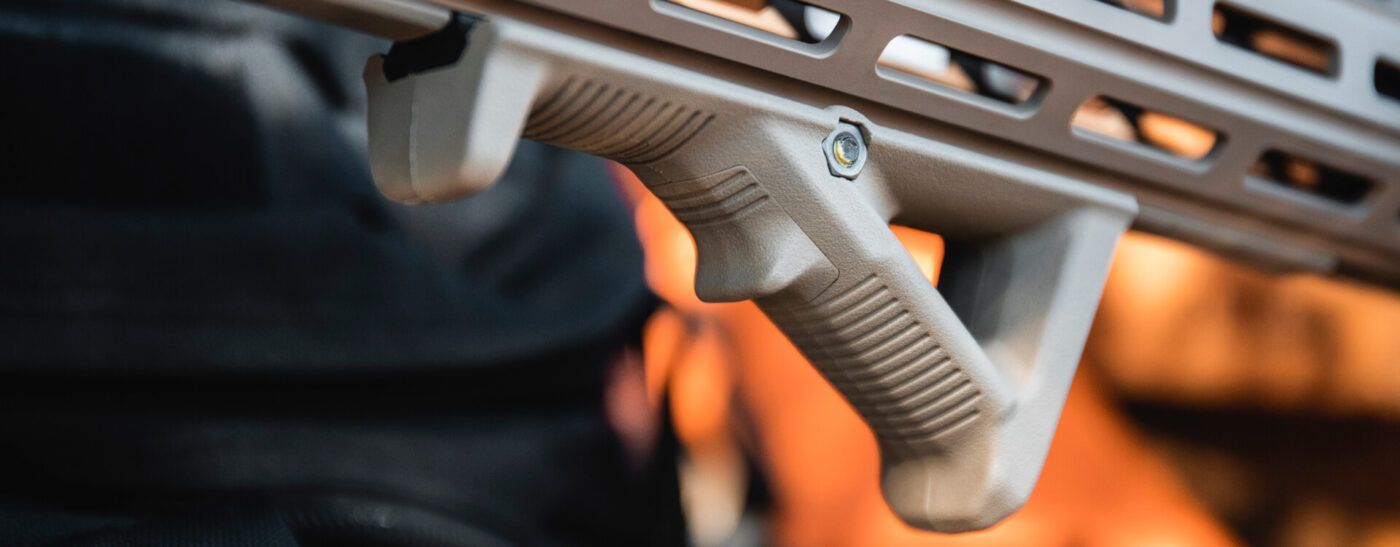
Angled foregrips sit at a rearward cant, typically between 20 and 45 degrees, which places the support wrist in a more natural position and supports a relaxed thumb-over-bore hold. This orientation reduces forearm muscle fatigue during extended shooting, speeds up target transitions, and integrates well with modern high-grip techniques favored in competition and tactical environments.
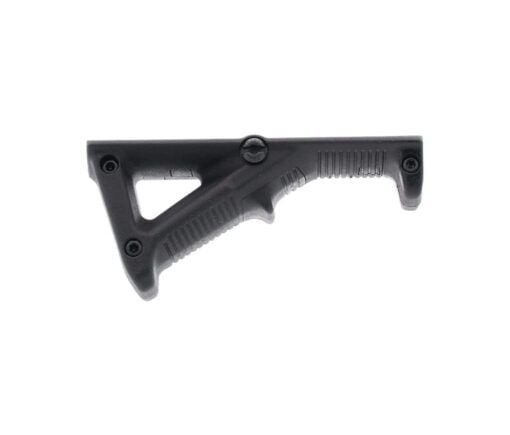
The angled design works with your body’s natural mechanics rather than against them. Where a vertical grip asks the wrist to deviate downward, an angled grip maintains a handshake-style alignment that keeps the support arm more relaxed and sustainable over time. Most shooters adapt to the feel quickly, and the improvement in transition speed becomes apparent within a single range session.
Angled grips also tend to remain more legally compliant across restrictive jurisdictions because many state definitions of a prohibited vertical foregrip require a 90-degree angle. Always verify the specific language in your state before assuming compliance.
Hand size matters here. Smaller hands perform better with compact angled grips that keep the wrist neutral, while larger hands benefit from fuller palm swells. Mount position is equally critical. Too far forward and you are reaching and losing control. Too far back and you are crowding your stance. Install your lights and slings first, then find the natural resting point for your support hand and mount the grip there.
Handstops: Minimalist Control Without the Bulk
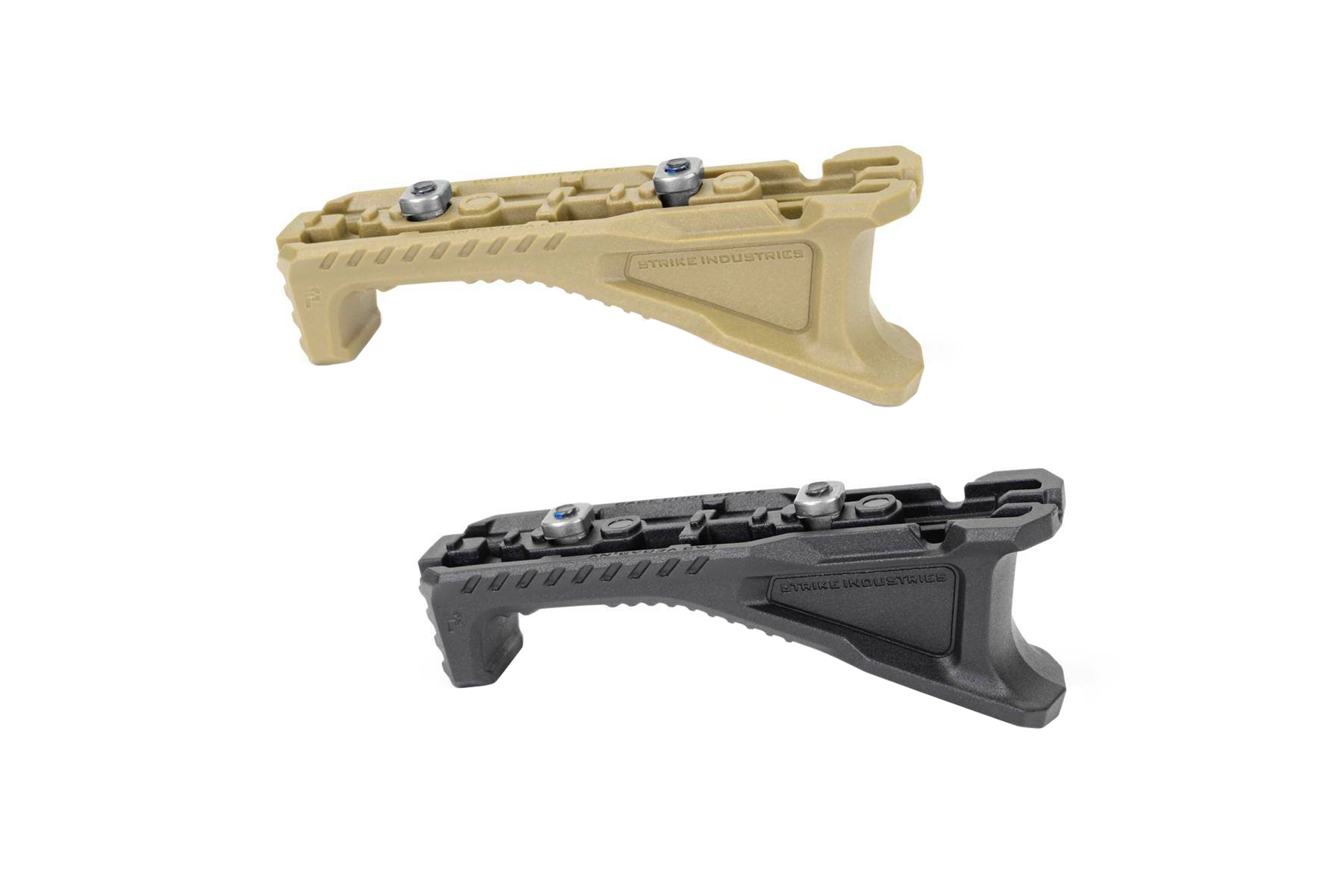
Handstops are the most minimalist option in the foregrip category. Rather than providing a grip surface, they act as a physical index point that prevents the support hand from sliding forward under recoil or during dynamic movement. They add virtually no weight, maintain a slim and snag-free profile, and keep the handguard clear for lights, lasers, and other accessories.

For shooters who have already developed a consistent C-clamp technique but want a reliable reference point, a handstop is often the best answer. It solves the specific problem of hand slippage without locking the wrist into a fixed angle or adding unnecessary hardware. In tight spaces such as doorways, vehicle interiors, and hunting terrain, the low-profile nature of a handstop is a genuine advantage over any full grip option.
Handstops also sidestep most legal classification issues entirely, as they do not meet the definition of a foregrip under most state statutes.
Matching Your Choice to Your Use Case
Your primary use should drive the decision more than any other factor.
For competition and speed-focused shooting, an angled foregrip in the 20 to 35-degree range gives you the fastest transitions and the most sustainable hold over long stages. Mount it where your hand falls naturally and confirm the position through timed drills before committing.
For home defense and close-quarters use, a handstop or low-profile angled grip keeps the rifle maneuverable in tight spaces while still providing a reliable index point. A suppressed build with added muzzle weight may justify a vertical grip for the extra leverage it provides.
For precision and barricade work, a vertical foregrip gives you the strongest mechanical advantage when bracing against barriers or shooting from supported positions over extended strings of fire.
For general range use and training, an angled foregrip or handstop provides the best balance of comfort, control, and versatility across different positions and drills.
Legal Considerations and Build Compliance
Any foregrip decision requires a review of your local laws, particularly if your AR-15 is configured as a pistol. In California and several other states, attaching a vertical foregrip to a pistol-lower build can reclassify the firearm under state law. Angled foregrips occupy a more favorable position in most jurisdictions, and handstops are rarely addressed by statute at all. If you are building in a restrictive state, confirm the specific legal language before purchasing.

Final Thoughts
The right M-LOK foregrip is the one that solves a specific problem in your shooting. That problem might be fatigue, inconsistent hand placement, transition speed, or compliance. Start by identifying what your current setup is actually missing. Test with a temporary solution before committing hardware to the rail.
If control and leverage are the priority, a vertical grip delivers. If speed, comfort, and natural wrist alignment matter most, an angled foregrip is the answer. If you want a clean, lightweight solution with a reliable index point, a handstop gets the job done with minimum compromise.
Browse the full selection of M-LOK foregrips, angled grips, and handstops at AR15Discounts.com, where competitive pricing and fast shipping make it easy to find the right upgrade for your build.
An M-LOK foregrip is a forward hand grip that mounts directly into the rectangular slots of an M-LOK compatible handguard. It gives your support hand a dedicated place to hold the rifle for better control. M-LOK works with special T-nuts (or cammed nuts) that insert into the slots. When you tighten the screws, the nuts rotate 90 degrees and lock securely behind the slot. This creates a strong, low-profile attachment without needing a full Picatinny rail section.
M-LOK foregrips are generally considered better for most modern AR-15 builds. They are lighter, have a slimmer and more comfortable profile, and allow more flexible placement along the handguard. Picatinny foregrips work well and have broader accessory compatibility, but they add extra weight and bulk. M-LOK is the current standard because it keeps the rifle lighter and more ergonomic while still providing rock-solid mounting.
Vertical grips (like the BCM Gunfighter Mod 3 or Magpul MVG) are best for recoil control. They let you pull the rifle straight back into your shoulder with strong leverage, reducing muzzle rise and helping with faster follow-up shots. They excel in rapid fire, barricade work, or heavier-recoiling setups.
It depends on your shooting style:Vertical — Better for maximum control, stability, and recoil management (great for tactical, precision, or static shooting).
Angled — Better for comfort, speed, and dynamic shooting (CQB, competition, or fast target transitions). Angled grips promote a natural wrist position and work well with C-clamp or thumb-over-bore techniques. Many shooters prefer angled for everyday use because they reduce fatigue and feel more natural.
Yes, indirectly. Foregrips don’t make the rifle mechanically more accurate, but they improve shooter consistency by providing a stable, repeatable hand position and better recoil control. This leads to tighter groups, faster follow-ups, and less fatigue—especially during strings of fire or dynamic drills.
The Magpul M-LOK AFG (Angled Fore Grip) is one of the best for beginners. It’s affordable, lightweight, easy to install, and promotes a natural, comfortable hand position with low snag risk. It’s forgiving and works well for most shooting styles while you figure out your preferences.