
AR-15 Basics, NFA, Suppressors
Breaking News: NFA Registration Ends for Suppressors and SBRs: What to Know
Oct
Table of contents
NFA registration is no longer required for suppressors, short-barreled rifles, short-barreled shotguns, or “any other weapons,” effective October 9, 2026. That is the core of ATF’s open letter, signed by Director Robert Cekada today and issued with a companion FAQ. The policy applies nationwide, not just to the plaintiffs who won in court this summer. For AR owners, it is the biggest change to suppressor and SBR ownership since 1934. It is also narrower than some headlines suggest, so the details matter.
What Changed With NFA Registration Today
Effective October 9, 2026, ATF no longer requires NFA approval to make or transfer an SBR, SBS, suppressor, or AOW. ATF will also stop requiring these items to be registered in the National Firearms Registration and Transfer Record. The FAQ goes further. ATF says it will not enforce the NFA’s bans on making, receiving, transferring, or possessing these items unregistered. It also will not enforce the NFA marking rule for them. The same goes for the 5861(j) ban on moving an unregistered NFA item in interstate commerce.
Two NFA provisions stay in force for these items. Possessing one with an obliterated serial number is still a crime under 5861(h). So is possessing one that was illegally imported, under 5861(k).
Why ATF Ended NFA Registration for These Items
The road here started with the One Big Beautiful Bill Act. It cut the making and transfer tax on SBRs, SBSs, suppressors, and AOWs from $200 to $0 starting January 1, 2026. Registration stayed on the books until August 5, 2026, when a Texas federal court ruled in Silencer Shop Foundation v. ATF. The court held that without a tax, NFA registration and approval for these items no longer rested on Congress’s taxing power. Nor could the rules stand on the commerce power, since Congress did not rely on it in 1934.
That injunction covered only the plaintiffs, their members, and their customers. The Justice Department told Congress it would not appeal, and the appeal window closed on October 5. Today ATF applied the same treatment to everyone as a matter of enforcement discretion. ATF described the step as consistent with a statement from the Attorney General issued the same day.
Who the NFA Registration Change Covers
The policy reaches anyone otherwise subject to the NFA rules for these four categories, licensed or not. Registration is now voluntary, but it has not gone away. ATF will keep the registry and will still accept and approve Form 4 transfers from anyone who wants to register. It will also take Form 1 to make an item, Form 3 for dealer transfers, and Form 2 for manufacturer reporting. That matters most in states that allow suppressors or SBRs only when they are federally registered. In those states, voluntary NFA registration on a Form 4 may be the only lawful path, so ask your dealer before you buy.
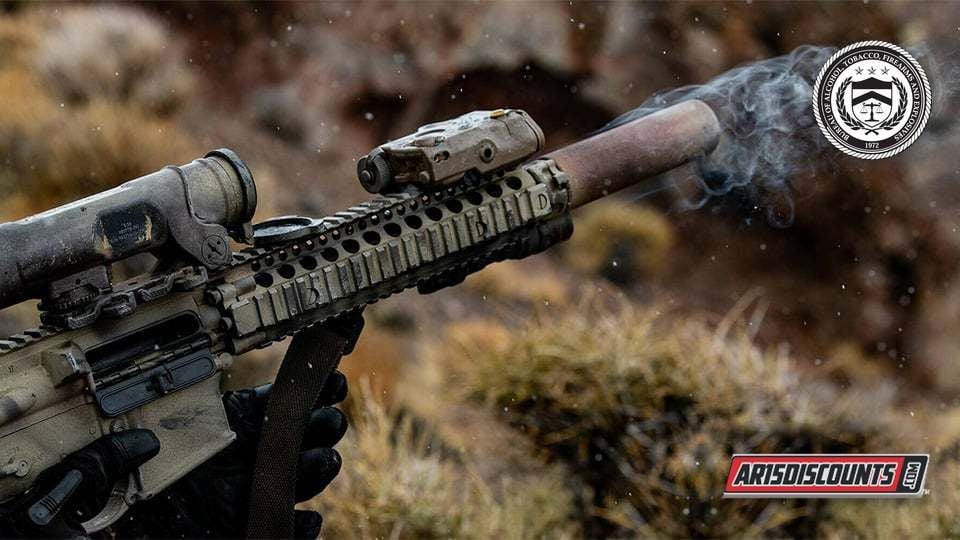
[IMAGE: Suppressed AR-15 carbine at the range]
Five Limits on the End of NFA Registration
First, the special occupational tax still applies. Dealers, manufacturers, and importers of NFA items must still pay it. A dealer without SOT status cannot use this policy to start selling them.
Second, machine guns and destructive devices are untouched. The $200 tax remains, and every NFA provision still applies to them.
Third, the Gun Control Act still governs. SBRs, SBSs, suppressors, and AOWs remain “firearms” under federal law. A dealer must complete a Form 4473, run a NICS background check unless an exemption applies, and keep records. Prohibited persons still may not possess them.
Fourth, SBRs and SBSs carry extra GCA rules. Under 18 U.S.C. 922(b)(4), a dealer may sell an SBR or SBS only with specific authorization from the Attorney General, and an approved NFA form used to serve that role. ATF is drafting new forms and regulations for a non-NFA approval process. Until they exist, ATF will not enforce 922(b)(4). Owners must still file a Form 20 before taking an SBR or SBS across state lines, even when it is unregistered.
Fifth, state and local laws have not changed. Most states tie NFA items to federal compliance or registration. ATF will not say whether an unregistered item qualifies under those laws. Some states ban most or all NFA items outright. ATF also warns that it is unclear whether state courts will apply the 18 U.S.C. 926A safe-passage protection to unregistered NFA items. Dealers still may not transfer anything in violation of state or local law.
What NFA Registration Changes Mean for AR Buyers
The rule buyers will notice first is residency. With limited exceptions, a dealer may sell a suppressor or AOW only to a resident of the state where the dealer is licensed. Private sellers also may not transfer these items to residents of other states. Your purchase still runs through a dealer in your home state.
For suppressor buyers in states where they are legal, the long Form 4 wait is no longer a federal requirement. ATF’s FAQ tells dealers to process suppressor sales like any other firearm. That means a Form 4473, a NICS check, and normal records. Dealer-to-dealer shipments no longer need an approved Form 3. That points to a buying process that looks much like picking up a rifle. Dealers and distributors will need time to update their own procedures, so expect some variation in the first weeks.
At AR15Discounts, our suppressor lineup still ships to your local FFL/SOT dealer, who handles the final transfer. Processing steps may change as the industry adjusts. Check the product page or contact our team for current timing before you order. Our earlier guide to new ATF rules in 2026 covers the tax change that set this in motion.
SBR builders should read the fine print. An upper receiver alone is not regulated, but pairing a short-barreled upper with a stocked lower makes an SBR. Federally, that no longer requires an approved Form 1 under this policy. State law still controls, and the Form 20 rule still applies for travel. If a short build is on your list, browse our complete uppers and confirm your state’s rules first. Our look at how suppressors changed the barrel length equation is a good companion read.
Can NFA Registration Come Back?
ATF says yes. Its FAQ notes that Congress could restore a tax. A court could also overturn the injunction, or the Department could rescind the policy. Federal law does not automatically grandfather unregistered NFA items. The Attorney General may declare an amnesty of up to 90 days, but is not required to. That risk is one reason some owners will keep filing voluntary forms.
This article is general information, not legal advice. Check your state and local laws. Talk to your dealer or a firearms attorney before you make, buy, or travel with an NFA item.
The Bottom Line on NFA Registration
ATF’s open letter turns a court win for a few plaintiffs into a nationwide policy. It removes the federal NFA registration and approval steps that defined suppressor and SBR ownership for 92 years. The Gun Control Act, the SOT requirement, the machine gun rules, and every state law still stand. Know your state’s rules and buy through a dealer at home. The path to a suppressed or short-barreled AR is now shorter than it has ever been.