
AR-15 Basics, AR-15 Parts Kits
AR-15 Kits Explained: Rifle Kits vs Upper Build Kits vs Lower Build Kits vs Builder Sets
Sep
Table of contents
- AR-15 Rifle Kits: The Most Complete Starting Point
- Upper Build Kits: More Control Over the Upper
- Lower Parts Kits: The Internals of the Lower
- Lower Build Kits: More Than Just Pins and Springs
- Builder Sets: The Starting Point for a Custom Rifle
- Receiver Sets: Matched Receivers Without as Much Commitment
- Rifle Kit or Builder Set?
- Lower Parts Kit or Lower Build Kit?
- Complete Upper or Upper Build Kit?
- Which AR-15 Kit Should You Buy?
- Why AR-15 Kits Still Make Sense
- FAQ
Shopping for AR-15 kits gets confusing faster than it should. A rifle kit, upper build kit, lower parts kit, lower build kit, builder set, and receiver set can all sound like slightly different versions of the same thing, but they are really intended for builders starting at very different points. Buy the wrong category and you may end up with duplicate parts, a pile of components that still leaves a major hole in the build, or a kit that requires considerably more assembly than you expected.
The better way to shop is to start with what is already sitting on your bench. If you have a stripped lower and want most of the rest of the rifle in one purchase, a rifle kit makes sense. If the lower is already complete, you can focus entirely on the upper. If you want to choose the barrel, trigger, stock, gas system, and other major components yourself, a builder set or receiver set gives you a much more open starting point. AR-15 kits are useful precisely because they let you decide how much of that parts selection has already been done for you.
AR-15 Rifle Kits: The Most Complete Starting Point
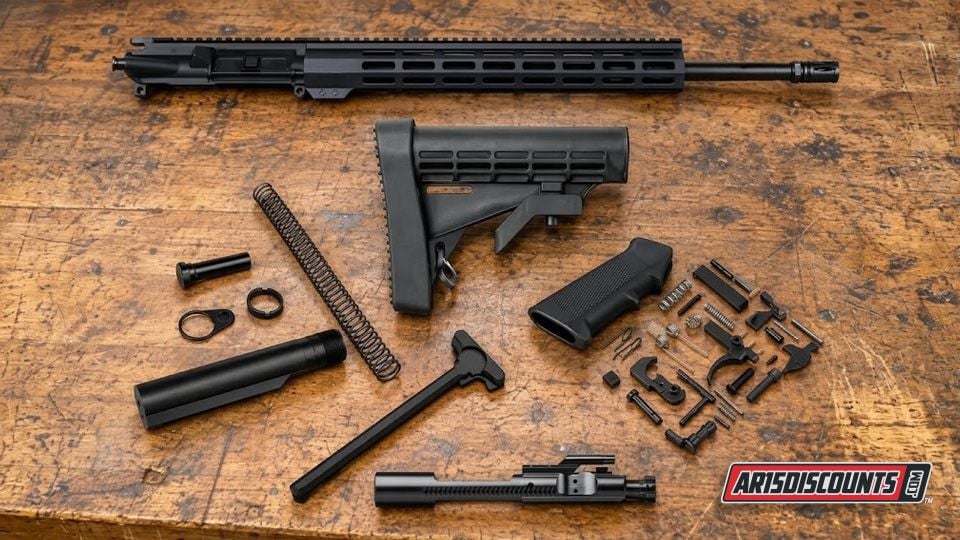
For someone beginning with a stripped lower receiver, an AR-15 rifle kit is generally the category that gets closest to a complete rifle without including the serialized lower itself. Rather than sourcing the upper, lower internals, buffer system, stock, grip, bolt carrier group, charging handle, and other components one at a time, the idea is to bundle most of what the builder needs into one package.
The exact contents still depend on the specific rifle kit, so it is important to read the product description rather than assuming every package is identical. Some use an assembled upper, which allows the builder to concentrate primarily on completing the lower receiver. Others give the buyer more choices in barrel length, handguard, furniture, or operating components. AR15Discounts also offers a .223/5.56 rifle kit configurator specifically intended to give the customer more control over the components that make up the finished build.
This is a particularly good approach for a first AR because assembling a lower lets the owner learn how the rifle’s controls and fire-control components fit together without immediately requiring the tools and setup involved in installing and properly assembling an upper. The stripped lower remains a separate purchase, but nearly everything surrounding it can be handled through the rifle kit.
For someone asking which of the various AR-15 kits is the simplest place to begin, this is usually it. You still get the experience of building the rifle, but much of the component-matching and shopping has already been handled.
Upper Build Kits: More Control Over the Upper
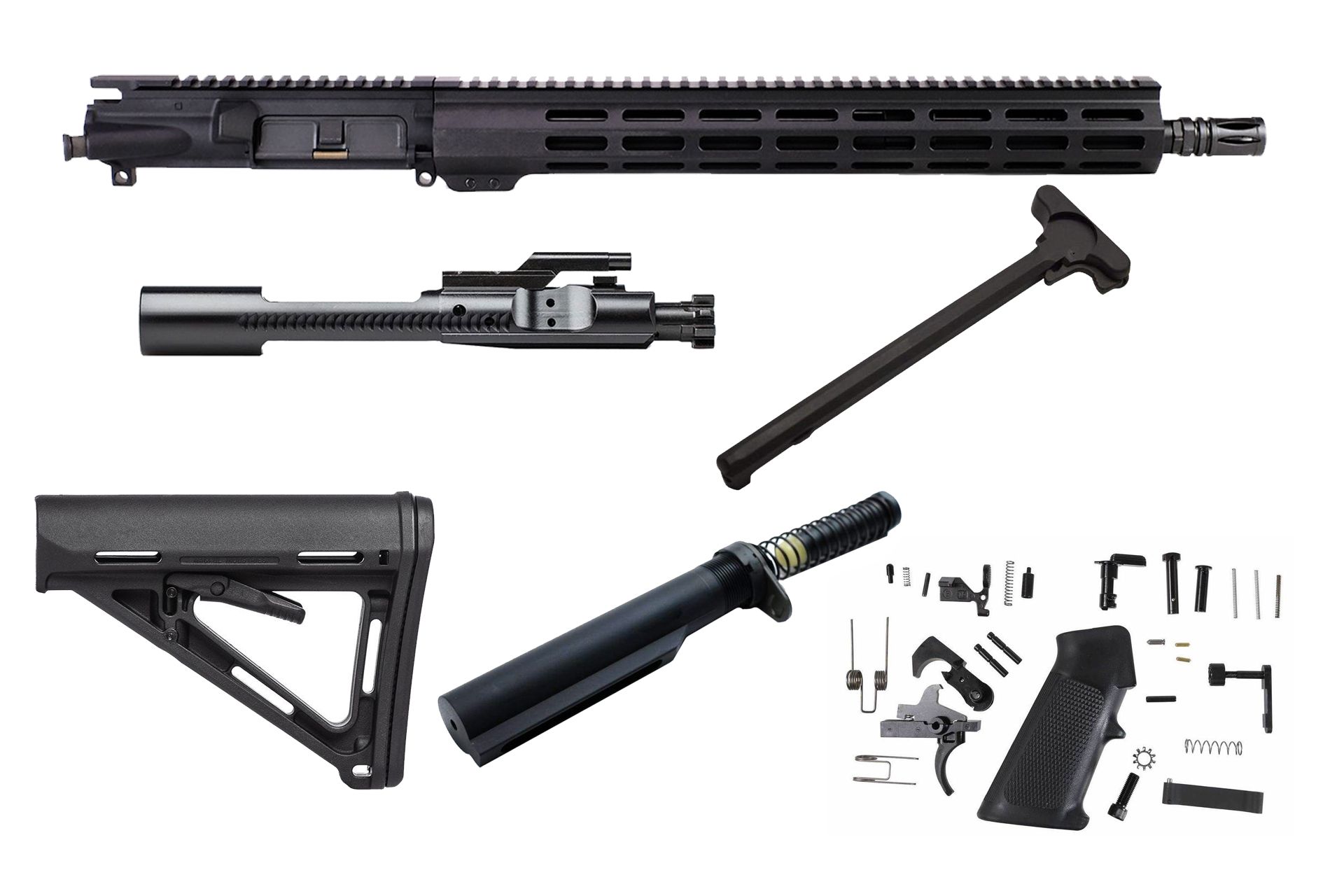
Upper build kits are much broader in scope, and that is an important distinction. There is no single universal parts list that defines every upper build kit. AR15Discounts currently groups receiver-and-handguard combinations, barreled upper combinations, and packages built around barrels and operating components under its Upper Build Kits category, so buyers need to look closely at what the individual package actually contains.
What these packages have in common is that they are intended to give the builder a coordinated starting point for the upper rather than a completely assembled, ready-to-pin-on upper receiver group. Depending on the kit, you may still need a barrel, gas block, gas tube, handguard, bolt carrier group, charging handle, muzzle device, or upper receiver. Another kit may already provide several of those components and leave only a few pieces for the customer to select.
That variability is actually the reason upper build kits are useful. Someone building around a particular barrel may want a compatible gas system and bolt carrier group but prefer to select the receiver and handguard separately. Another builder may already own the operating parts and simply want a receiver and rail combination that works together. The current AR15Discounts category reflects that range rather than forcing every upper build kit into a single formula.
If you already have a complete lower and simply want to change calibers, barrel length, or the general purpose of the rifle without assembling anything, a complete upper is usually the easier solution. If selecting and assembling the upper is part of the project, an upper build kit makes considerably more sense.
Lower Parts Kits: The Internals of the Lower
A lower parts kit is the traditional answer when you already have a stripped lower receiver but want to choose the furniture and buffer system separately. These kits generally concentrate on the pins, springs, detents, controls, and other smaller components needed to turn the receiver into a functioning lower.
The exact contents vary here too. AR15Discounts currently sells everything from complete lower parts kits to versions that intentionally leave out the fire-control group, pistol grip, or both. The category also includes more specialized pin-and-spring packages and configurable options, which is a good reminder that the words “lower parts kit” do not automatically mean every component below the upper receiver is included.
A conventional kit may include the magazine catch, bolt catch, selector, takedown pins, pivot pin, springs, detents, trigger components, and pistol grip, but a builder planning to install a premium trigger may deliberately choose a kit without the fire-control group. Someone who already owns a preferred grip may do the same thing there.
This is where lower parts kits offer more flexibility than a larger bundled package. You are buying the small parts that are tedious to source one at a time while leaving yourself free to choose the components that have a bigger influence on how the rifle feels.
Lower Build Kits: More Than Just Pins and Springs
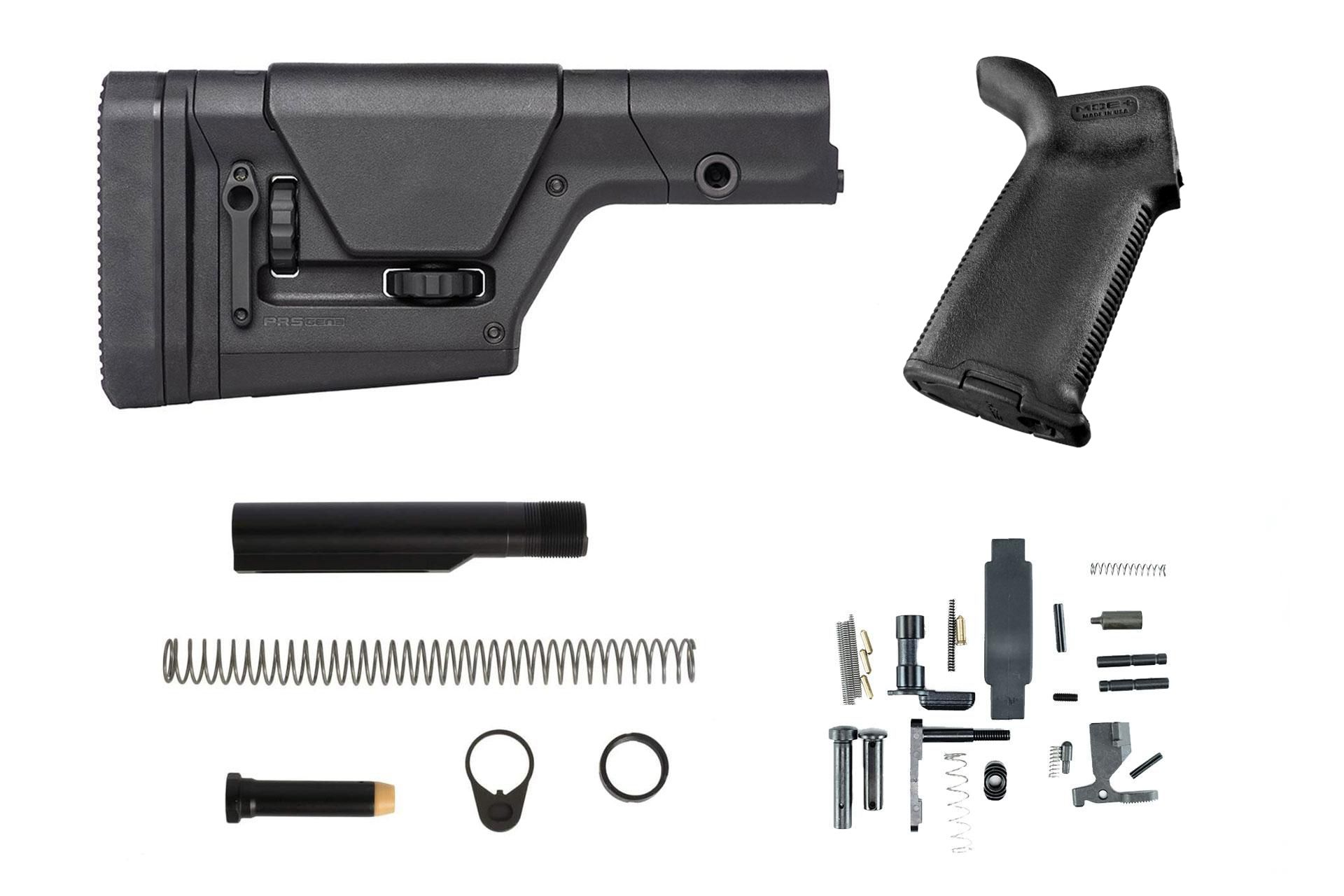
A lower build kit generally goes beyond the small internal components and packages more of what is needed to complete the entire lower receiver. Depending on the kit, that can mean combining the lower parts with the stock, receiver extension, buffer, buffer spring, pistol grip, and related hardware.
The difference is less about a rigid industry definition and more about how much of the lower the package is intended to complete. A lower parts kit usually gives you the mechanical internals. A lower build kit typically takes the next step and adds some or most of the larger components surrounding those internals.
The Magpul PRS lower build kit offered through AR15Discounts is a useful example because it combines a PRS stock, receiver extension and buffer components, grip, and lower parts while intentionally leaving out the fire-control group. That makes sense for the kind of precision-oriented rifle likely to use a PRS stock, since many buyers building that type of rifle are going to choose their own trigger anyway.
This is also why the product description matters more than the name. One lower build kit may be very close to everything needed to finish a stripped lower, while another may be deliberately built around the assumption that the customer already has a trigger, grip, stock, or another major component.
Builder Sets: The Starting Point for a Custom Rifle
Builder sets move in almost the opposite direction from rifle kits. Instead of trying to supply most of the parts required for the finished gun, they usually give the builder a coordinated group of major structural components and leave most of the operating system up to the customer.
That frequently means a matched upper receiver, lower receiver, and handguard, although the exact contents depend on the manufacturer and individual set. The advantage is that these major pieces are already designed to work together visually and dimensionally, which provides a much cleaner starting point for a premium or heavily customized rifle.
From there, the builder can select the barrel, bolt carrier group, trigger, gas system, charging handle, stock, buffer system, muzzle device, and nearly everything else based on the intended purpose of the rifle. Someone building a lightweight carbine can take the project in one direction, while a precision or suppressed build using the same general receiver foundation might look completely different.
This category makes the most sense for someone who already understands what goes into an AR and does not want a manufacturer or kit assembler making most of those decisions. The builder set provides the foundation, not the finished recipe.
There is also a legal and shipping consideration. If the set includes a serialized lower receiver, that component is treated as the firearm for transfer purposes and cannot simply be handled like a box of ordinary unregulated parts. Buyers should pay attention to the product’s transfer requirements and applicable federal, state, and local law.
Receiver Sets: Matched Receivers Without as Much Commitment
A receiver set occupies similar territory but is generally a simpler foundation. Rather than combining the receivers with the handguard and potentially other matching components, a receiver set is typically centered on the upper and lower receiver themselves.
That gives the builder the advantage of starting with components from the same manufacturer or product family while leaving the choice of handguard completely open. For someone who already has a particular rail in mind, that can actually be preferable to buying a larger builder set.
The distinction is worth understanding because builder sets and receiver sets often appeal to the same customer. Both are geared toward ground-up builds where the owner intends to choose most of the rifle’s important components individually. The difference is how far the matched foundation extends. With a receiver set, the upper and lower are the focus. With many builder sets, the coordinated package extends into the handguard and sometimes beyond it.
As with builder sets, a receiver set containing a serialized lower will have transfer requirements that do not apply to ordinary parts kits.
Rifle Kit or Builder Set?
These two categories represent opposite ends of the AR-15 kit spectrum. A rifle kit reduces the number of decisions you need to make, while a builder set gives you more of those decisions back.
For a first rifle, that usually favors the rifle kit. It keeps compatibility problems and forgotten parts to a minimum while still giving the owner the experience of assembling the lower and understanding how the major assemblies come together.
A builder set starts making more sense once you know exactly what barrel, handguard geometry, trigger, gas system, stock, buffer setup, and other components you want. At that point, buying a rifle kit could actually be wasteful because you may immediately replace several of the parts you just purchased.
Neither one is inherently better. They are designed for completely different builders.
Lower Parts Kit or Lower Build Kit?
The same logic applies on a smaller scale. If you have a stripped lower and already know you want a specific stock, buffer system, trigger, and grip, a lower parts kit gives you the smaller internal components without forcing those larger decisions on you.
If you simply want to get most of the lower completed without making six separate purchases, a lower build kit is usually the more convenient option. You still need to check the contents carefully because some packages intentionally leave out components such as the trigger or grip, but in general the lower build kit is meant to cover more of the finished lower.
The choice comes down to whether you value customization or convenience more for that particular project.
Complete Upper or Upper Build Kit?
If you already have a complete lower and do not particularly care about assembling an upper, there is little reason to make the project harder than it needs to be. A complete upper lets you attach an already assembled upper receiver group to a compatible lower and move on to setup, function checks, sights or optics, and range use.
An upper build kit is for someone who wants more control over how that upper comes together. That may mean selecting a particular barrel and gas system, choosing a rail length around a suppressor or accessory setup, or simply wanting the experience of assembling the upper personally.
Neither route is more legitimate than the other. The complete upper prioritizes convenience, while the upper build kit prioritizes component selection and involvement in the build.
Which AR-15 Kit Should You Buy?
The easiest way to make the decision is to look at what you already have rather than what the package is called. If you own a stripped lower and need almost everything else, start with a rifle kit. If you only need to complete that lower, choose between a lower parts kit and a lower build kit based on how many of the larger components you want included.
If your lower is already finished, decide whether you want to build or simply install the upper. A complete upper handles the latter, while an upper build kit gives you more control over the assembly and component choices.
For a ground-up custom build, a receiver set or builder set usually makes more sense because it avoids paying for parts you already know you will replace. A receiver set gives you a matched upper and lower foundation, while a builder set often carries that matched approach into the handguard and other major structural components.
Once you look at AR-15 kits this way, the category names stop being confusing. They simply describe different levels of completion and different starting points.
Why AR-15 Kits Still Make Sense
The biggest advantage of the AR platform has always been modularity, but that same modularity can make a first build unnecessarily complicated. There are dozens of small parts, several major assemblies, and an almost endless number of ways to combine them. Buying every component individually offers maximum control, but it also creates more opportunities to forget a spring, duplicate a part, or discover halfway through the build that two components do not work together the way you expected.
AR-15 kits reduce that friction without taking away the modular nature of the rifle. A rifle kit can handle most of the sourcing for a new builder, while an upper or lower build kit narrows the project to one half of the rifle. Lower parts kits keep the smaller hardware organized while letting the builder choose the components that matter most to feel and performance. Receiver sets and builder sets take the opposite approach by providing a quality foundation while leaving nearly every major performance decision open.
That is ultimately the best way to choose between them. Do not buy the kit with the longest parts list simply because it appears to offer more. Look at what you already own, decide which parts you genuinely want to choose yourself, and use the right AR-15 kit to fill the space between the project on your bench and the rifle you actually want to finish.
FAQ
For most first-time builders starting with a stripped lower, an AR-15 rifle kit is one of the easiest approaches because it bundles most of the remaining components and often reduces the amount of upper-receiver assembly required.
If you need most of the rest of the rifle, look at a rifle kit. If you only want to finish the lower, choose a lower parts kit or lower build kit depending on whether you want to select the stock, buffer system, grip, and trigger separately.
Buy a complete upper if you want the simplest option. Choose an upper build kit if you want to select and assemble more of the upper components yourself.
A lower parts kit generally focuses on the internal controls, pins, springs, detents, and related small parts. A lower build kit typically adds more of the larger components needed to complete the lower, such as the buffer system, stock, or grip, although exact contents vary.
A receiver set generally centers on a matched upper and lower receiver. A builder set often expands that matched foundation to include a handguard or other coordinated components. Because there is no universal industry parts list for either term, always check the individual product contents.
If the package includes a serialized lower receiver, normal firearm transfer requirements apply and the lower generally must be transferred through an appropriate FFL. Packages containing only unregulated components are treated differently, so check the specific product before ordering.
A rifle kit generally bundles the largest portion of the finished rifle short of the lower receiver, which can make it a strong value when you actually want the included components. A smaller kit can be the better value if a larger package includes parts you already plan to replace.
AR15Discounts carries products intended for a variety of configurations and maintains a restricted-state-compliant section, but legality depends on the particular parts, finished configuration, state, and sometimes local law. Buyers should verify the current restrictions that apply to the specific build before ordering.