
Optics
Vortex Diamondback Tactical 4-16×44 vs 6-24×50: Which One Should You Buy?
Nov
Table of Contents
- Vortex Diamondback Tactical 4-16×44 vs 6-24×50 Specs
- Which Vortex Diamondback Is Better for an AR-15?
- What About an AR-10, .308, or 6.5 Creedmoor Bolt Gun?
- Glass Quality at Maximum Magnification
- Low-Light Performance
- MOA vs. MRAD: Which Should You Choose?
- Which Mount Should You Use?
- Honest Cons of the Vortex Diamondback Tactical 4-16×44
- Honest Cons of the Vortex Diamondback Tactical 6-24×50
- Vortex Diamondback Price and Current Deals
- Vortex Diamondback Tactical 4-16×44 vs 6-24×50: Which Should You Buy?
- Frequently Asked Questions About the Vortex Diamondback Tactical
Choosing between the Vortex Diamondback Tactical 4-16×44 and the Vortex Diamondback Tactical 6-24×50 mostly comes down to how far you plan to shoot, what rifle you are mounting the scope on, and how much magnification you realistically need.
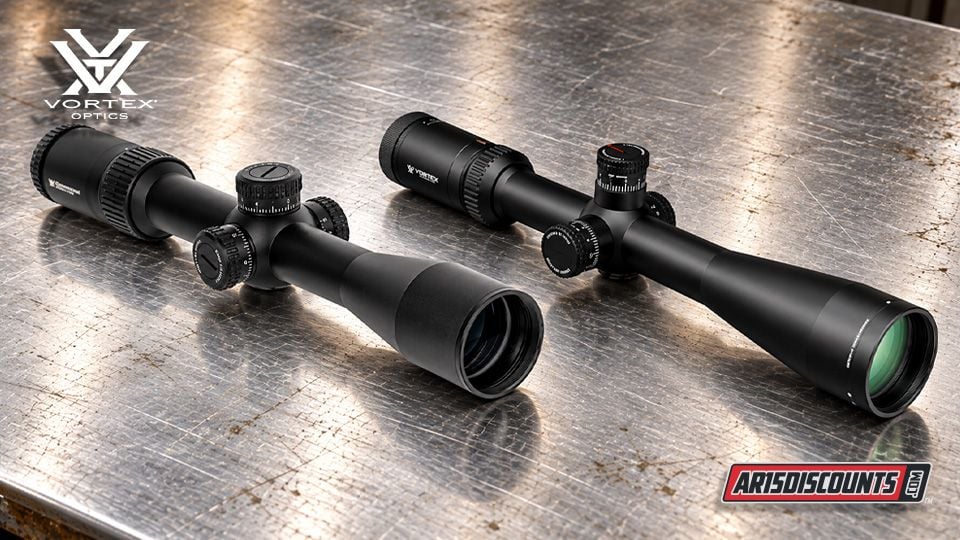
Both scopes are part of the Vortex Diamondback Tactical lineup and share many features. Both use a 30mm tube, first focal plane reticle, exposed tactical turrets, side parallax adjustment, and Vortex’s XD optical system. They also come with EBR-2C reticles in MOA or MRAD.
The major difference is magnification. The 4-16×44 provides a wider usable range for general-purpose rifles, while the 6-24×50 gives precision shooters additional magnification for smaller targets and longer distances.
For an AR-15, especially one chambered in 5.56 NATO, the 4-16×44 will usually be the more practical choice. For an AR-10, precision bolt gun, or rifle chambered in .308 Winchester or 6.5 Creedmoor that will spend considerable time beyond 300 yards, the 6-24×50 becomes more attractive.
Here’s how the two Vortex Diamondback Tactical scopes compare.
Vortex Diamondback Tactical 4-16×44 vs 6-24×50 Specs
Both scopes use a first focal plane design. That means the reticle grows and shrinks with magnification, keeping subtensions accurate throughout the magnification range.
| Specification | Diamondback Tactical 4-16×44 | Diamondback Tactical 6-24×50 |
|---|---|---|
| Magnification | 4-16x | 6-24x |
| Objective Lens | 44mm | 50mm |
| Tube Diameter | 30mm | 30mm |
| Focal Plane | First Focal Plane | First Focal Plane |
| Eye Relief | 3.8 in. | 3.9 in. |
| Field of View at 100 Yards | 26.9-6.7 ft. | 18-4.5 ft. |
| Parallax | 20 yds. to infinity | 10 yds. to infinity |
| Length | 14.06 in. | 14.28 in. |
| Weight | 23.1 oz. | 24.6 oz. |
| MOA Adjustment | 1/4 MOA | 1/4 MOA |
| MOA Travel Per Rotation | 15 MOA | 15 MOA |
| Maximum Elevation – MOA | 85 MOA | 65 MOA |
| Maximum Windage – MOA | 85 MOA | 65 MOA |
| MRAD Adjustment | 0.1 MRAD | 0.1 MRAD |
| MRAD Travel Per Rotation | 6 MRAD | 6 MRAD |
| Maximum Elevation – MRAD | 25 MRAD | 19 MRAD |
| Maximum Windage – MRAD | 25 MRAD | 19 MRAD |
The 4-16×44 weighs 23.1 ounces, while the 6-24×50 weighs 24.6 ounces, a difference of only 1.5 ounces. The 6-24×50 is also only slightly longer. The bigger differences are magnification, field of view, objective diameter, and adjustment range.
One specification that’s easy to overlook is elevation travel. The MOA version of the 4-16×44 offers 85 MOA of maximum elevation adjustment compared with 65 MOA for the 6-24×50. In MRAD, that’s 25 MRAD and 19 MRAD, respectively.
That extra travel can matter when dialing for longer distances, especially if the rifle isn’t using a canted scope base.


Which Vortex Diamondback Is Better for an AR-15?
For most AR-15 rifles chambered in 5.56 NATO, the Vortex Diamondback Tactical 4-16×44 is the more balanced option.
A 4x minimum magnification remains useful at relatively short distances, while 16x provides far more magnification than most shooters need at typical 5.56 distances.
The 4-16×44 also provides a wider field of view. At 4x, you get 26.9 feet at 100 yards compared with 18 feet at 100 yards with the 6-24×50 at its lowest 6x setting.
That wider view can make target acquisition easier during range sessions, hunting, or when transitioning between targets.
A 16-inch AR-15 used from roughly 100 to 500 yards is therefore a natural match for the 4-16×44. You still have enough magnification to spot impacts and shoot relatively small targets without turning the rifle into a highly specialized long-range setup.
The Vortex Diamondback Tactical 6-24×50 certainly works on an AR-15, but 24x is more magnification than many 5.56 shooters use routinely. If the rifle primarily stays on a bench and you enjoy shooting small groups or small targets at distance, however, having 24x available can still be useful.
What About an AR-10, .308, or 6.5 Creedmoor Bolt Gun?
Move to an AR-10 or precision bolt-action rifle, and the 6-24×50 starts making considerably more sense.
A .308 Winchester or 6.5 Creedmoor rifle intended for shooting between 300 and 600 yards can take advantage of the additional magnification. At those distances, moving from 16x up toward 20x or 24x can help when aiming at small targets or evaluating groups.
The larger 50mm objective also becomes more useful on a rifle, where size and weight matter less.
That doesn’t mean the 4-16×44 suddenly becomes inadequate. Sixteen-power magnification is plenty for a substantial amount of shooting at 300, 400, 500, and even 600 yards.
If you expect to carry the rifle hunting, shoot from improvised positions, or frequently engage closer targets, the 4-16×44’s 4x low end may actually make it more versatile.
For a dedicated bench, target, or entry-level precision rifle, though, the Vortex Diamondback Tactical 6-24×50 provides more room to grow.
Glass Quality at Maximum Magnification
Both scopes use Vortex XD lens elements designed to improve resolution and color fidelity. Vortex also uses fully multi-coated lenses in the Diamondback Tactical series.
However, magnification changes how any optic appears.
One mistake shooters sometimes make is assuming that 24x automatically provides a clearer image than 16x. Higher magnification makes the target appear larger, but it can also magnify atmospheric distortion, mirage, movement, and optical imperfections.
At 24x, you may notice environmental conditions more than you would at 16x. On a hot range, for example, mirage can become significant enough that backing the 6-24×50 down to 18x or 20x actually gives you a more useful sight picture.
The 4-16×44 has an advantage here simply because 16x is its ceiling. Its magnification range suits a broad mix of practical shooting distances without tempting you to use more magnification than conditions support.
The 6-24×50 gives you more flexibility. You don’t have to use 24x just because it’s available. Run it at 12x, 16x, or 18x when conditions demand it and turn it up when the extra detail actually helps.
Low-Light Performance
The 6-24×50 has a larger objective lens, but objective diameter alone doesn’t determine low-light performance.
Exit pupil is also important. You can estimate it by dividing the objective diameter by the magnification.
At maximum magnification:
- 4-16×44 at 16x: approximately 2.75mm exit pupil
- 6-24×50 at 24x: approximately 2.08mm exit pupil
Despite the larger objective lens, the 6-24×50 is pushed to a much higher magnification at 24x. As a result, simply turning it all the way up does not necessarily produce the brightest low-light image.
At the same 16x magnification, however, the 50mm objective has a theoretical advantage: it produces an exit pupil of about 3.1mm, compared with 2.75mm from the 44mm objective.
In practical terms, if light is fading, reducing magnification is often more beneficial than simply choosing the scope with the biggest objective.
For hunters, that 4x minimum magnification on the 4-16×44 is useful when shooting during the first or last portions of legal shooting light.
MOA vs. MRAD: Which Should You Choose?
Both Diamondback Tactical models are available in MOA and MRAD configurations.
Neither system is inherently more accurate. The best choice is usually whichever measurement system you understand and plan to use consistently.
The MOA versions adjust in 1/4 MOA increments. The MRAD versions adjust in 0.1 MRAD increments.
If your ballistic data, spotting calls, and previous scopes are already in MOA, stay with MOA. If you use MIL-based ballistic data or plan to participate in precision rifle competition where MRAD is common, the MRAD version may be easier to work with.
The key is keeping your reticle and turret system consistent, rather than trying to mentally convert between the two while shooting.
Which Mount Should You Use?
Both scopes have 30mm tubes, so you’ll need a 30mm mount or ring set.
For an AR-15 or AR-10, a 30mm cantilever scope mount is generally the easiest solution. A cantilever mount moves the scope forward while keeping the mount attached to the upper receiver, helping shooters establish comfortable eye relief without bridging the receiver and handguard.
AR-platform mounts commonly place the optic’s centerline approximately 1.4 to 1.5 inches above the rail. Vortex currently offers several compatible 30mm cantilever options, including its Sport and Pro-series mounts. AR15Discounts also lists multiple Vortex 30mm cantilever mounts.
For a bolt-action rifle, conventional 30mm rings are usually preferable.
Ring height depends on the rifle, rail, barrel contour, stock or chassis, and objective diameter. The goal is to mount the scope low enough for a comfortable cheek weld while leaving adequate clearance between the objective bell and the barrel or rail.
The 50mm objective on the 6-24×50 may require slightly taller rings than the 44mm objective on the 4-16×44, depending on the rifle.
Don’t automatically buy “high” rings simply because the optic has a large objective. Measure the setup first.


Honest Cons of the Vortex Diamondback Tactical 4-16×44
The 4-16×44 is arguably the more versatile of these two Vortex rifle scopes, but it isn’t perfect.
Its biggest limitation is obvious: 16x is the maximum magnification.
For general AR-15 shooting, that is rarely a problem. For someone trying to see small bullet holes, shoot tight groups, or consistently engage small targets at 600 yards and beyond, more magnification can help.
It also weighs 23.1 ounces. That is reasonable for a first focal plane tactical scope, but it’s still substantial if you’re trying to build an especially lightweight hunting or general-purpose AR-15.
The exposed turrets are another consideration. They’re excellent when you regularly dial elevation, but hunters carrying rifles through brush may prefer capped turrets that are less likely to be accidentally bumped.
Finally, don’t confuse Diamondback Tactical with Vortex’s more expensive precision scopes. You get a capable FFP optic at a relatively accessible price, but shooters who want higher-end glass, more advanced turret systems, or competition-focused features may eventually look at models like the Vortex Venom or Viper PST.
Honest Cons of the Vortex Diamondback Tactical 6-24×50
The biggest compromise with the Vortex Diamondback Tactical 6-24×50 is that its additional magnification can encourage shooters to use more power than they actually need.
At 24x, the field of view narrows to 4.5 feet at 100 yards. Mirage, rifle movement, and atmospheric distortion also become considerably more noticeable at high magnification.
Its 6x minimum magnification makes it less comfortable for relatively close shots or quickly locating targets.
The 24.6-ounce weight isn’t dramatically heavier, but add a substantial cantilever mount, and you’ve created a fairly large optics package for a lightweight AR-15.
The 6-24×50 also has less total elevation and windage adjustment than the 4-16×44. That’s worth considering if you plan to do extreme long-range dialing.
Vortex Diamondback Price and Current Deals
We often list the Vortex Diamondback Tactical FFP 4-16×44 at $399.99. The scope is offered with EBR-2C MOA and MRAD reticle options.
The Vortex Diamondback Tactical FFP 6-24×50 is listed starting at $449.99, compared with a Vortex MSRP of $649.99.
That means the current difference is about $50.
AR15Discounts has also offered an open-box Vortex Diamondback Tactical 6-24×50 for $449.99, though that listing was out of stock when checked. Prices and inventory can change, so check the current product listings before ordering.
For only $50 more, the 6-24×50’s additional magnification is reasonably priced if you actually need it. If you’re building a general-purpose 5.56 AR-15, however, paying extra just for 24x doesn’t automatically make it the better optic.
Vortex Diamondback Tactical 4-16×44 vs 6-24×50: Which Should You Buy?
For a 5.56 AR-15 used for range shooting, hunting, and general-purpose use, the Vortex Diamondback Tactical 4-16×44 is the more versatile choice. Its 4x low end, wider field of view, lighter weight, and 16x maximum give an AR-15 plenty of usable magnification without unnecessarily specializing the rifle.
The 6-24×50 makes more sense for a precision-oriented AR-10 or bolt-action rifle, particularly one chambered in .308 Winchester, 6.5 Creedmoor, or another cartridge intended for extended-range shooting.
Think about where your rifle will spend most of its time.
If most of your shooting happens inside 500 yards, 4-16x is difficult to argue against.
If you’re routinely shooting small targets between 300 and 600 yards, want more magnification for group shooting, or plan to stretch farther as your skills improve, the 6-24×50 gives you more room at the top end.
Neither requires choosing the scope with the biggest numbers. The better Vortex Diamondback scope is the one whose magnification range matches the rifle and the distances you actually shoot.
Shop Vortex Diamondback Scopes at AR15Discounts.com
Whether you’re building a precision AR-15, upgrading an AR-10, or adding new glass to a bolt-action rifle, the Vortex Diamondback lineup delivers useful features without immediately jumping into premium-scope pricing.
Shop Vortex Diamondback scopes at AR15Discounts.com to compare current models, MOA and MRAD reticles, mounts, and available deals. From the versatile Diamondback Tactical 4-16×44 to the longer-range 6-24×50, you can match your optic to your rifle, shooting distance, and budget.
Frequently Asked Questions About the Vortex Diamondback Tactical
Both Diamondback Tactical scopes cover a wide range of rifles and shooting styles. Here are quick answers to some of the most common questions when choosing between them.
The 4-16×44 is generally the better all-around choice. Its 4x low magnification and wider field of view are more useful when hunting or shooting closer targets, while 16x still provides ample magnification for most AR-15 range work.
Yes. Its 4-16x magnification range works particularly well on precision-oriented AR-15 builds. It has a 30mm tube, first focal plane reticle, adjustable parallax, exposed turrets, and 3.8 inches of eye relief.
Yes. Sixteen-power magnification is enough for most targets within that distance range. However, the 6-24×50 can be worthwhile if you primarily use the rifle from a bench or prone position and regularly shoot small targets or groups where extra magnification helps.
Vortex says its VIP Warranty applies regardless of where you buy the product and covers Vortex products for damage or defects, with exceptions including loss, theft, deliberate damage, and cosmetic damage that doesn’t affect performance. That makes warranty coverage a significant advantage when considering a legitimate open-box Vortex optic.
The Diamondback Tactical offers a practical entry point for someone attending their first precision rifle match. Its first-focal-plane reticle, exposed turrets, and MOA or MRAD adjustments provide the basic tools needed for dialing and holding corrections.
As experience grows, shooters may want the features and optical performance of higher-tier scopes like the Vortex Venom or Viper PST, but a more expensive optic isn’t required to learn the fundamentals of precision rifle shooting.
A cantilever mount suits the AR platform because it lets the scope sit farther forward while the mount stays attached to the upper receiver. Both Diamondback Tactical scopes use a 30mm tube, so choose a quality 30mm cantilever mount that provides proper height and eye relief.
For most 16-inch 5.56 AR-15 rifles, 24x is more magnification than you’ll routinely need. The 4-16×44 generally offers better value and a more useful magnification range. The 6-24×50 becomes more attractive when you use the rifle primarily for precision shooting from supported positions.
Our site currently lists the Vortex Diamondback Tactical FFP 4-16×44 starting at $399.99. Pricing and inventory can change, so check the current listing before ordering.
For more resources, visit our sister site at www.dirtybirdusa.com.