
AR-15 Parts
Mil-Spec vs. Commercial: Buffer Tubes, Triggers, Charging Handles
Oct
Table of Contents
When shopping for AR-15 parts, you’ll see the terms mil-spec and commercial everywhere. While they may sound like simple quality indicators, the differences can involve dimensions, materials, manufacturing standards, and compatibility. Understanding mil-spec vs. commercial parts is especially important when choosing buffer tubes, triggers, charging handles, and stocks.
For some components, the difference is primarily about fit. For others, commercial aftermarket parts may actually offer features beyond traditional military specifications. Knowing what the terminology means can help you select parts that work together without assuming that one label automatically makes a component better.
What Does Mil-Spec Mean?
Mil-spec is short for military specification. In the AR platform, the term generally describes a component manufactured to dimensions, materials, tolerances, or performance standards associated with military-pattern rifles.
However, a commercially sold AR-15 is not automatically a military rifle simply because it contains mil-spec-style parts. The term is frequently used in the civilian market to identify components that follow commonly accepted military-pattern dimensions.
Commercial parts are manufactured for the civilian market and do not necessarily follow those same specifications. That does not automatically mean they are lower quality. Many premium aftermarket products are technically commercial components because they were designed to improve ergonomics, weight, adjustability, or performance beyond a basic military configuration.
Commercial vs Mil-Spec Buffer Tube
The commercial vs. mil-spec buffer tube comparison matters most for compatibility. A typical AR-15 mil-spec buffer tube has an outside diameter of about 1.148 inches, while a commercial receiver extension is about 1.168 inches. That small difference can affect compatibility with the stock.
Mil-spec tubes also normally feature a straight, flat rear profile. Commercial tubes are often slightly larger and may have an angled rear section.
Because of these dimensional differences, you need to match the stock to the receiver extension. A mil-spec stock or mil-spec buttstock is designed around the smaller mil-spec tube diameter. A commercial spec stock is designed around the larger commercial tube.
Although some commercial stocks may physically slide onto a mil-spec extension, they can fit loosely. Mil-spec stock generally will not fit properly over the larger commercial tube. Measuring the tube with calipers is one of the most reliable ways to identify which version you have.
For modern AR builds, mil-spec-sized receiver extensions have become the more common choice because the aftermarket offers an extensive selection of compatible stocks.
Mil-Spec vs Commercial AR-15 Triggers
Triggers work differently because no separate physical mounting standard is commonly described as a “commercial trigger size.” Instead, mil-spec generally refers to the traditional single-stage fire-control design and its expected operating characteristics.
A traditional mil-spec-style trigger prioritizes reliability and predictable function rather than an extremely light or competition-style break. Military specifications commonly place trigger pull weight within roughly the 5.5- to 9.5-pound range, depending on the specific firearm specification.
Commercial aftermarket triggers can offer lighter pull weights, shorter resets, two-stage operation, cassette-style construction, or other performance-oriented features.
This is a good example of why mil-spec vs. commercial should not automatically be interpreted as good versus bad. A mil-spec trigger may suit someone who wants a simple, proven configuration, while an aftermarket trigger may better suit a precision, competition, hunting, or upgraded general-purpose build.
Mil-Spec vs Commercial Charging Handles
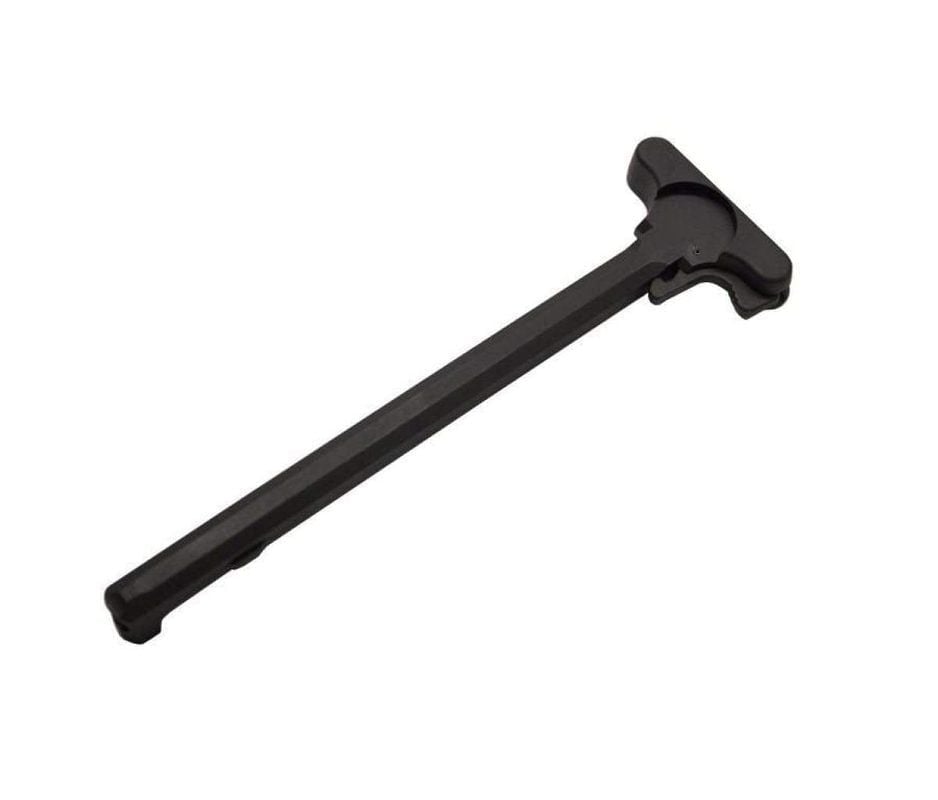
Charging handles follow the same general principle. A standard mil-spec-style charging handle uses the traditional AR-15 shape and dimensions designed to fit a standard upper receiver.
Commercial aftermarket charging handles may retain those basic dimensions while adding larger latches, ambidextrous controls, reinforced construction, improved gripping surfaces, or features intended to better manage gas around the rear of the receiver.
For many builders, upgrading the charging handle is less about abandoning mil-spec compatibility and more about adding features.
When shopping, confirm that the handle is designed for your specific platform. Standard AR-15 charging handles and AR-10/LR-308 charging handles are generally not interchangeable, even if they look similar.
Which Should You Choose?
For most modern AR-15 builds, mil-spec dimensions provide a useful compatibility baseline. This is especially true with receiver extensions because choosing the correct tube determines which adjustable stocks will properly fit.
Other components give you more flexibility. A traditional trigger or charging handle may work perfectly well, while aftermarket options can provide features unavailable on basic military-pattern parts.
When selecting parts, focus on compatibility, materials, intended use, and manufacturer quality rather than the mil-spec label alone. Shop compatible AR-15 buffer tubes, stocks, triggers, charging handles, and related AR-15 parts from AR15discounts to find components that fit your next build.
Where to Buy Mil-Spec and Commercial AR-15 Parts
Understanding mil-spec vs. commercial makes it easier to choose parts that fit correctly and match your build’s needs. Whether you are replacing a buffer tube, upgrading a trigger, installing a new stock, or adding an improved charging handle, compatibility should always come first.
For a wide selection of AR-15 buffer tubes, stocks, triggers, charging handles, and other AR-15 parts, shop AR15Discounts.com. With options for everything from basic replacement components to performance-focused upgrades, AR15Discounts.com makes it easy to find the right parts for your next build or upgrade.



Mil-Spec vs Commercial FAQ
Understanding a few common questions about mil-spec vs. commercial components can make shopping for compatible AR-15 parts much easier.
Mil-spec means military specification and generally refers to parts following military-pattern dimensions, materials, tolerances, or performance requirements.
Mil-spec parts follow established military-pattern specifications, while commercial components may use different materials, dimensions, designs, or performance features.
Measure its outside diameter with calipers. A mil-spec tube is approximately 1.148 inches, while a commercial tube is approximately 1.168 inches.
No. Commercial tubes have a slightly larger outside diameter.
Some may slide onto the tube, but the fit can be loose. For proper fit, match the stock to the receiver extension specification.
Not automatically, but mil-spec tubes generally provide much broader compatibility with today’s aftermarket stock selection.
A mil-spec-style trigger generally uses the traditional single-stage AR fire-control design built around established military-pattern specifications.
Traditional mil-spec trigger specifications generally range from about 5.5 to 9.5 pounds.
A mil-spec-style charging handle follows traditional AR-15 dimensions and design specifications rather than incorporating specialized aftermarket features.
They are generally compatible with standard AR-15-pattern upper receivers, but builders should always verify compatibility with proprietary or non-standard upper designs.
For additional support, check out our sister site at www.dirtybirdusa.com.