
AR-15 Basics, Uncategorized
What is an AR-15? Beginner’s Guide
Sep
Table of Contents
- What Does AR-15 Mean?
- Is an AR-15 Fully Automatic?
- AR-15 vs. M16
- AR-15 vs. M4
- How Does an AR-15 Work?
- Major Parts of an AR-15
- What Caliber Does an AR-15 Use?
- Why Is the AR-15 So Popular?
- What Is an AR-15 Commonly Used For?
- What Accessories Can You Add to an AR-15?
- How Much Does an AR-15 Cost?
- What Makes a Good Starter AR-15?
- Are All AR-15 Rifles the Same?
The AR-15 is one of the most recognizable and widely discussed rifle platforms in the United States, but it is also one of the most misunderstood. For someone new to firearms, terms such as AR-15, M4, M16, upper receiver, lower receiver, bolt carrier group, direct impingement, and free-float handguard can make the platform seem more complicated than it really is.
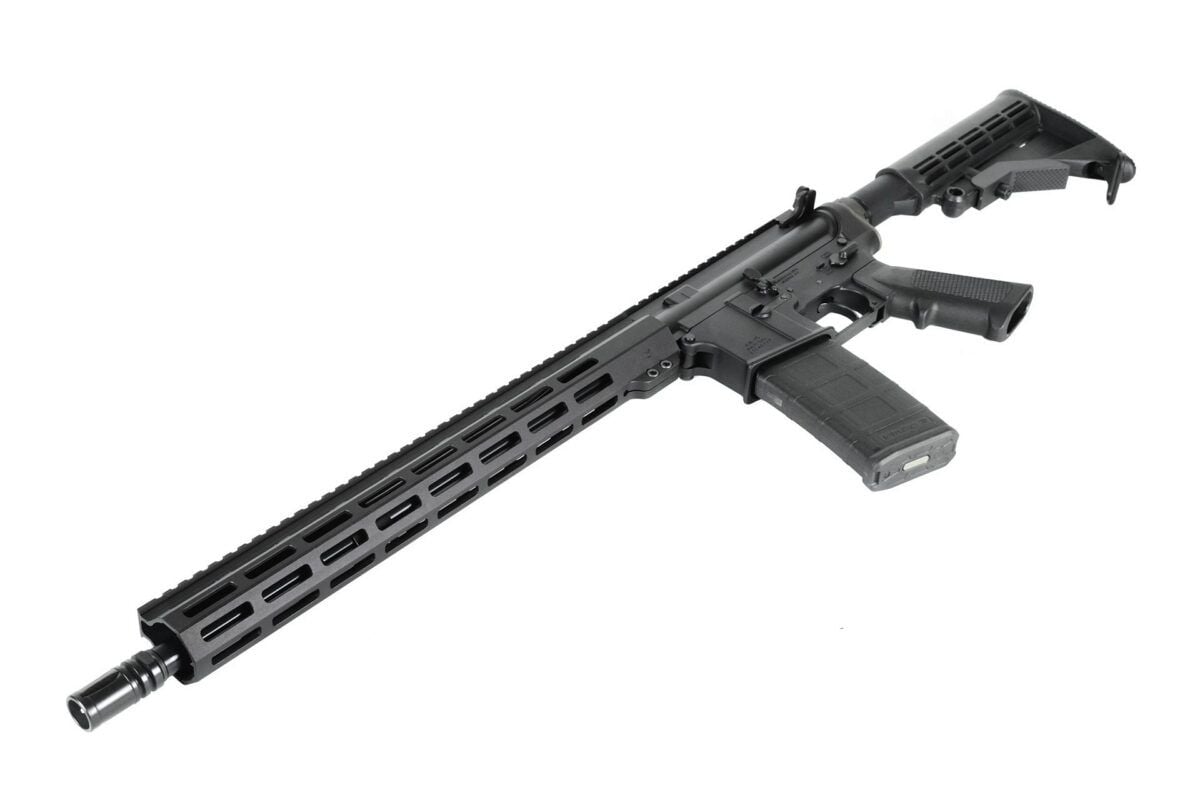
At its core, the modern AR-15 is a lightweight, magazine-fed, semi-automatic rifle platform known for its modular construction. Rather than a single rifle made by one company, today’s AR-15 is better understood as a broad family of compatible rifles, parts, and components made by many different manufacturers.
That modularity is one of the biggest reasons the AR-15 has remained so popular. A shooter can purchase a complete rifle, assemble one from compatible AR-15 parts, or start with a basic rifle and change individual components over time. For beginners, the best place to start is understanding what an AR-15 is, how it works, and what separates one rifle from another.
What Does AR-15 Mean?
One of the most common misconceptions about the AR-15 involves its name. The “AR” does not stand for “assault rifle” or “automatic rifle.” It comes from ArmaLite Rifle, referring to ArmaLite, the company that developed the original platform.
The AR-15 traces its roots to firearms designer Eugene Stoner and ArmaLite’s development work during the 1950s. The design built on concepts used in earlier ArmaLite rifles and focused on reducing weight while using modern materials such as aluminum and polymer. ArmaLite later sold the manufacturing rights to Colt, which further developed and marketed the rifle.
Over time, the design evolved into military and commercial variants. Today, the AR-15 name is commonly used to describe a much broader family of semi-automatic rifles based on the same general architecture. Dozens of companies now manufacture complete AR-15 rifles, receivers, barrels, handguards, triggers, bolt carrier groups, stocks, and other compatible components.
Is an AR-15 Fully Automatic?
A standard commercial AR-15 is a semi-automatic rifle, which means it fires one round for each separate pull of the trigger. After a cartridge fires, the rifle uses energy from the shot to cycle the action, eject the spent case, chamber the next cartridge, and reset for the next shot.
That automatic loading process can be confusing, but semi-automatic does not mean fully automatic. The rifle does not continue firing simply because the trigger remains pressed. The shooter must release and press the trigger again before another round can be fired.
This distinction is important when comparing a civilian AR-15 with military rifles that may have selective-fire capabilities. A typical commercial AR-15 style rifle is designed for semi-automatic operation only.
AR-15 vs. M16
The AR-15 and M16 share a common design heritage and can look very similar from the outside. However, they are not the same firearm. The M16 evolved from the original AR-15 design for military use.
The M16 also includes selective-fire capability. Depending on the model, it may offer semi-automatic, burst, or fully automatic fire. Modern civilian AR-15 rifles are generally semi-automatic only.
They also use different fire-control components than military M16 rifles. That is why appearance alone doesn’t reliably indicate how a rifle operates. A commercial AR-15 can resemble an M16 while functioning very differently.
AR-15 vs. M4
The M4 is a military carbine descended from the AR-15 and M16 family. It was designed to be shorter and more compact. It typically features a shorter barrel, adjustable stock, and selective-fire capability.
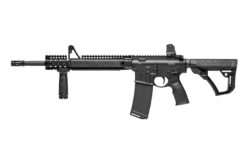
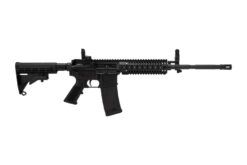
Many civilian AR-15-style rifles borrow the M4’s appearance and general dimensions. Common features include 16-inch barrels, collapsible stocks, flat-top upper receivers, and modern handguards. However, a civilian AR-15 that resembles an M4 is not automatically an M4.
The main differences involve the fire-control system, barrel configuration, intended use, and legal classification. Appearance alone does not determine how the firearm is classified or how it operates.
How Does an AR-15 Work?
The AR-15 operating cycle is relatively straightforward once you understand the major components. Pressing the trigger causes the hammer to strike the firing pin. The firing pin then contacts the primer of the chambered cartridge.
As the cartridge fires, expanding gas pushes the bullet through the barrel. Some gas is redirected through the gas system. This gas helps cycle the bolt carrier group.
The bolt carrier moves rearward and unlocks the bolt. It also extracts the spent casing and compresses the buffer spring.
The buffer spring then pushes the bolt carrier group forward again. The bolt strips another cartridge from the AR-15 magazine. It then chambers the cartridge and locks into battery.
The rifle is now ready for the next trigger pull. Loading and cycling happen automatically, but the shooter still initiates each shot.
Major Parts of an AR-15
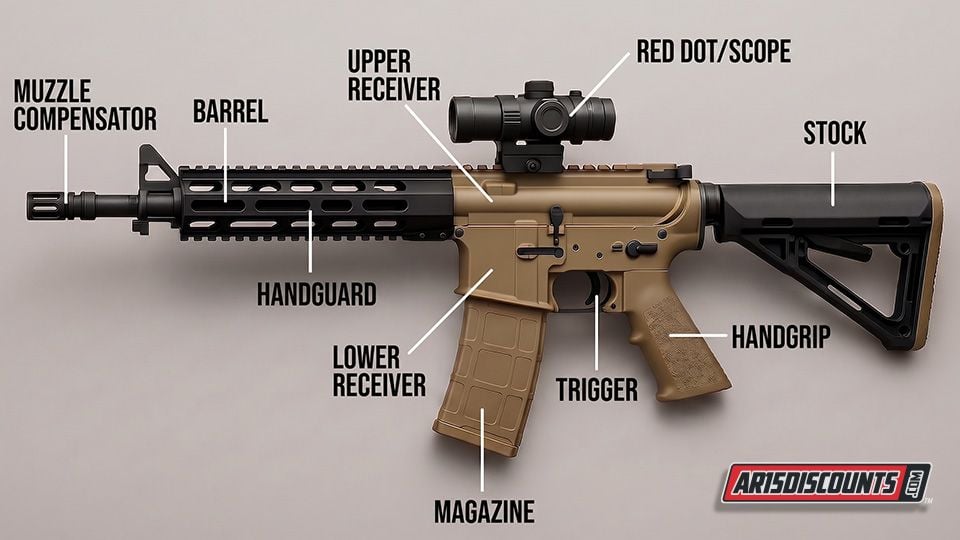
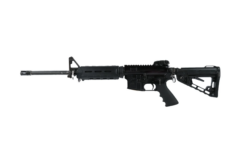
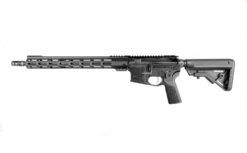
One reason the AR-15 is beginner-friendly is its simple component layout. You can divide the rifle into several major groups. Understanding these parts makes shopping for complete rifles and individual components much easier.
Upper Receiver
The upper receiver forms the rifle’s top half and contains many parts involved in firing and cycling. A complete upper commonly includes the receiver, barrel, handguard, gas system, bolt carrier group, and charging handle.
Complete uppers let shooters change major rifle characteristics without replacing the lower receiver. Depending on compatibility, owners can change calibers, barrels, handguards, and other upper components.
Lower Receiver
The AR-15 lower forms the rifle’s bottom half and houses several important controls. These include the fire-control group, safety selector, magazine release, bolt catch, pistol grip, and buffer assembly.
Federal law generally treats the lower receiver as the serialized firearm. You can buy many other AR-15 components separately without federal serialization requirements.
Barrel
The barrel affects the rifle’s weight, handling, velocity, and accuracy potential. A 16-inch barrel works well for many general-purpose AR-15 rifles.
This length balances compact handling with solid ballistic performance. Hunters, competitors, and precision shooters often choose longer barrels.
Manufacturers also offer shorter barrels. However, some shorter-barreled configurations can trigger additional federal or state legal requirements.
Bolt Carrier Group
The bolt carrier group, commonly called the BCG, performs much of the mechanical work involved in cycling the rifle. It contains the bolt, firing pin, cam pin, and several other important components.
These parts help lock the action, extract spent cases, and chamber the next round. BCG quality can play an important role in overall reliability.
Barrel quality, gas system design, and proper assembly also matter when choosing a reliable AR-15 rifle.
Charging Handle
The AR-15 charging handle allows the shooter to manually retract the bolt carrier group. You can use it to load, clear, or manually cycle the rifle.
Basic charging handles work well for most shooters. Larger or ambidextrous designs can make operation easier from either side.
Handguard
AR-15 handguards surround the barrel and provide a place to support the rifle. Modern free-float handguards often use M-LOK attachment slots for accessories.
The handguard can affect weight, balance, accessory placement, and overall comfort. Choosing the right design can also improve how the rifle feels during use.
Trigger
The AR-15 trigger is part of the fire-control system and directly affects how the rifle feels. Basic rifles often include a standard mil-spec-style trigger.
Upgraded rifles may use improved single-stage or two-stage triggers. These designs can offer a cleaner break, shorter reset, or more consistent feel.
Beginners do not necessarily need a premium trigger to get started.
Stock
The AR-15 stock attaches to the rear receiver extension and provides shoulder support. Many rifles use adjustable stocks for easier fit and positioning.
These stocks let you adjust the length of pull for different shooters or shooting positions. Fixed stocks are also available for traditional or precision-oriented builds.
Choosing a comfortable buttstock for an AR-15 can noticeably improve overall handling.
What Caliber Does an AR-15 Use?
The AR-15 is most commonly associated with 5.56 NATO and .223 Remington. However, the platform can support many other cartridges.
Compatibility depends on the upper receiver, barrel, bolt, and magazine configuration. Common chamberings include .300 Blackout, 6.5 Grendel, 6mm ARC, and .350 Legend.
Other options include .450 Bushmaster, .22 LR, and several pistol-caliber configurations. This flexibility is one of the AR platform’s major advantages.
Shooters can choose a caliber based on their intended use. Common applications include target shooting, hunting, competition, and recreational range use.
The correct AR-15 ammo always depends on the firearm’s chambering. Shooters should never assume ammunition is compatible based on appearance alone.
Why Is the AR-15 So Popular?
The AR-15 is popular because it combines modularity, parts availability, good ergonomics, and relatively light weight. It can also be configured for many different purposes.
Its modular design is a major advantage. Owners can change the AR-15 stock, handguard, trigger, charging handle, pistol grip, optic, or muzzle device.
You can also buy complete uppers and lowers separately in compatible configurations. This makes it easier to customize or update the rifle over time.
The aftermarket is another major factor. Many manufacturers produce AR-15 parts and accessories at a wide range of price points.
The controls are also designed for straightforward operation. With proper instruction, shooters can quickly learn the safety selector, magazine release, bolt catch, and charging handle.
What Is an AR-15 Commonly Used For?
AR-15 rifles are used for many lawful sporting and recreational purposes. Common uses include target shooting, competition, firearm training, hunting, collecting, and home defense.
Different configurations work better for different purposes. A lightweight carbine can make a good starter AR for general range use.
A precision-focused rifle may use a longer barrel, a magnified optic, an upgraded trigger, and a bipod. These features can better support longer-range shooting.
Some people use the term AR-15 sniper rifle for precision-oriented configurations. However, “precision AR-15” is usually a more accurate description for civilian setups.
What Accessories Can You Add to an AR-15?
The accessory market is one of the AR-15 platform’s defining features. Common AR-15 accessories include optics, slings, bipods, lights, foregrips, stocks, handguards, pistol grips, and muzzle devices.
An AR-15 foregrip can change how the support hand interacts with the rifle. Optics can also change how you use the rifle.
Red-dot sights are often suited for close-range target shooting. Magnified optics are generally better for longer-range applications.
Suppressors are another accessory option for AR-15 rifles. However, AR-15 suppressors are subject to federal requirements and possible state restrictions.
Beginners usually benefit from starting with a dependable rifle and adding accessories over time. This approach helps avoid unnecessary upgrades before real preferences develop.
How Much Does an AR-15 Cost?
One of the most common questions from new buyers is: How much does an AR-15 cost? There is no single answer. The AR-15 price can vary significantly depending on the manufacturer and included components.
Barrel quality, handguards, triggers, furniture, coatings, and assembly standards can all affect the final price. Included accessories may also increase the overall cost.
A budget-friendly AR-15 usually focuses on dependable basic components without expensive upgrades. These rifles can be a good choice for first-time buyers. Owners can also upgrade individual parts later as their needs change.
Mid-level rifles generally include better components that improve durability, handling, or overall performance. These may include upgraded barrels, handguards, bolt carrier groups, or furniture.
A premium AR-15 may feature higher-grade barrels, premium triggers, ambidextrous controls, and advanced handguards. It may also include enhanced BCGs, upgraded finishes, and specialized components.
Buyers should budget more than the average AR-15 price. Magazines, optics, ammunition, cleaning equipment, storage, and training can increase the total cost.
What Makes a Good Starter AR-15?
A good starter AR does not need to be the most expensive rifle available. For most beginners, reliability, common parts compatibility, and simplicity are more important than premium features.
A practical first rifle will often use a widely available caliber such as 5.56 NATO, common magazines, a conventional barrel length, and components that are easy to replace or upgrade later.
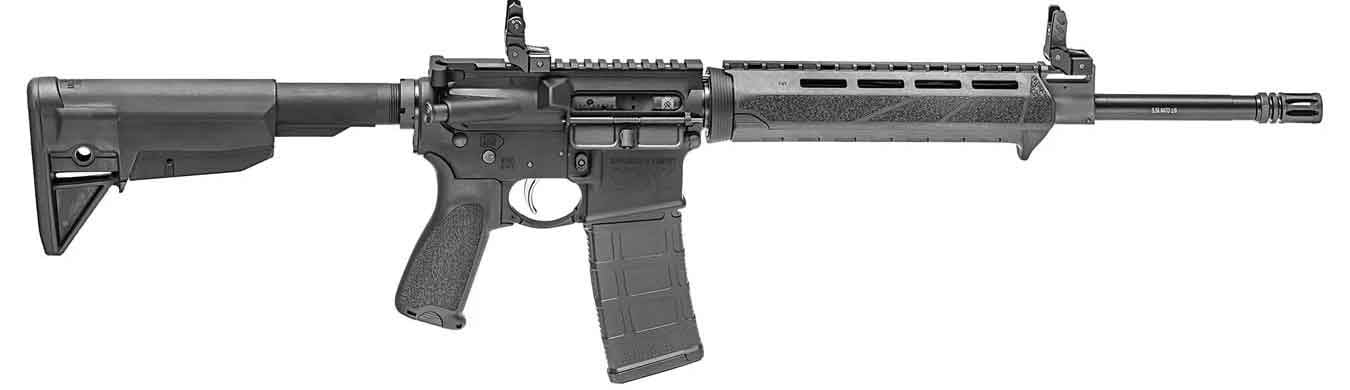
A free-float handguard, adjustable stock, and decent trigger can be useful features, but beginners shouldn’t feel every aftermarket upgrade is necessary. A basic rifle from a reputable manufacturer can provide a strong foundation that you can improve gradually.
That ability to grow with the owner is one of the platform’s biggest strengths.
Are All AR-15 Rifles the Same?
No. Two AR-15 rifles can look nearly identical while using very different components underneath.
Differences may include barrel material, barrel profile, twist rate, gas system length, bolt carrier group, trigger system, handguard construction, controls, stock, muzzle device, receiver machining, coatings, overall weight, and quality-control standards.
That’s why you should view lists of top-rated AR-15 rifles as starting points rather than universal answers. The best AR-15 for one shooter may not be the best choice for another.
A hunter, recreational shooter, competitor, collector, and first-time rifle owner can all have very different priorities.
Final Thoughts: Where to Buy AR-15 Rifles
The AR-15 is a modular semi-automatic rifle platform that can be configured for a wide range of uses, from recreational shooting to hunting, competition, and precision applications. Its adaptability, parts availability, and large aftermarket make it a popular choice for beginners and experienced shooters alike.
If you’re researching where to buy AR-15 rifles, AR15Discounts.com offers complete AR-15 rifles for sale along with lowers, uppers, barrels, bolt carrier groups, handguards, triggers, stocks, magazines, optics, and other parts and accessories.
Whether you’re looking to buy an AR-15 as your first rifle or build a more premium setup, focus on reliability, intended use, and components that fit your budget.
FAQ: Understanding the AR-15
If you’re new to AR-15 rifles, several basic questions tend to come up repeatedly. The following answers cover the terminology, history, and design differences that beginners should understand before choosing a rifle or starting a build.
“AR” stands for ArmaLite Rifle, referring to the company that originally developed the platform. It does not stand for assault rifle or automatic rifle.
ArmaLite developed the original AR-15 in the 1950s, and it is closely associated with firearms designer Eugene Stoner. ArmaLite later sold the manufacturing rights to Colt.
A modern civilian AR-15 is generally semi-automatic only. The military M16 incorporates selective-fire capability and can operate in additional firing modes depending on the specific version.
The M4 is a military carbine developed from the M16 family. Civilian AR-15 carbines may resemble an M4 externally, but they generally operate as semi-automatic rifles and use different fire-control components.
The platform combines modularity, relatively light weight, widespread parts availability, familiar controls, good accuracy potential, and extensive customization options.
It means the rifle automatically cycles the action and chambers the next cartridge after firing, but the shooter must press the trigger separately for each shot.
AR-15 rifles are commonly used for recreational shooting, target practice, competition, firearm training, hunting where permitted, collecting, and other lawful purposes.
The rifle is built around upper and lower receiver assemblies, and many of its parts follow widely used dimensional standards. This lets owners replace or upgrade individual components without buying an entirely new rifle.
No. Manufacturers use different barrels, triggers, bolt carrier groups, gas systems, handguards, stocks, controls, finishes, and quality-control standards.
A typical commercial AR-15 is a semi-automatic rifle that fires one round for each separate trigger pull. The term “assault rifle” has traditionally referred to military rifles with selective-fire capability, although legal and political definitions can vary.
For additional support, check out our sister site at www.dirtybirdusa.com.