
AR Rifle, AR-15 Basics, AR-15 Lower Receivers
Buffer Weight and Recoil Reduction Myths
Jul
Table of contents
- The Myth That the Buffer System Is Just Dead Weight
- The Myth That Heavier Buffers Always Soften Recoil
- The Myth of One Universal Buffer Weight in an AR-15 Lower Receiver
- The Myth That Tubes and Springs Are Interchangeable Afterthoughts
- The Myth That Buffer Weight Alone Fixes Overgassing
- The Truth About Choosing Buffer, Tube, and Spring
- The Myth That Aftermarket Options Are Pure Luxury
- Final Truths on the AR-15 lower Receiver and Buffers, Tubes, and Springs
The AR-15 platform invites endless customization, yet one area that consistently sparks confusion and debate involves the buffer, tube, and spring that complete the rear end of the rifle. Many shooters chase after heavier buffers in the belief that more mass automatically equals softer recoil and smoother operation. Others swap parts randomly, hoping for a magic fix. The reality is more nuanced. Proper selection of buffer weight, the matching tube, and a quality spring forms a tuned system that manages bolt carrier speed, extraction timing, and felt impulse. Getting it wrong can introduce short-stroking, failures to feed, or unnecessary wear. Understanding how these components interact reveals that many popular ideas about recoil reduction amount to little more than myth, while the truth lies in balanced matching rather than extremes.

TL;DR- Too Long Didn’t Read
The blog discusses the often misunderstood role and adjustment of the buffer, tube, and spring system within the AR-15 platform. Debunking common myths, it emphasizes the importance of selecting compatible components to ensure optimal performance and reliability.
- The buffer system is crucial to cycling performance, contrary to beliefs that it’s just added weight.
- Heavier buffers do not always equate to reduced recoil; proper balance with the gas system is vital.
- No universal buffer weight exists; component choices depend on specific gun configurations and intended use.
- Tubes and springs play significant roles; they are not interchangeable without considering the system dynamics.
- Buffer weight alone cannot fix overgassing; a holistic approach is needed involving multiple system elements.
- Aftermarket options can improve functionality, not just serve as luxury upgrades.
The Myth That the Buffer System Is Just Dead Weight
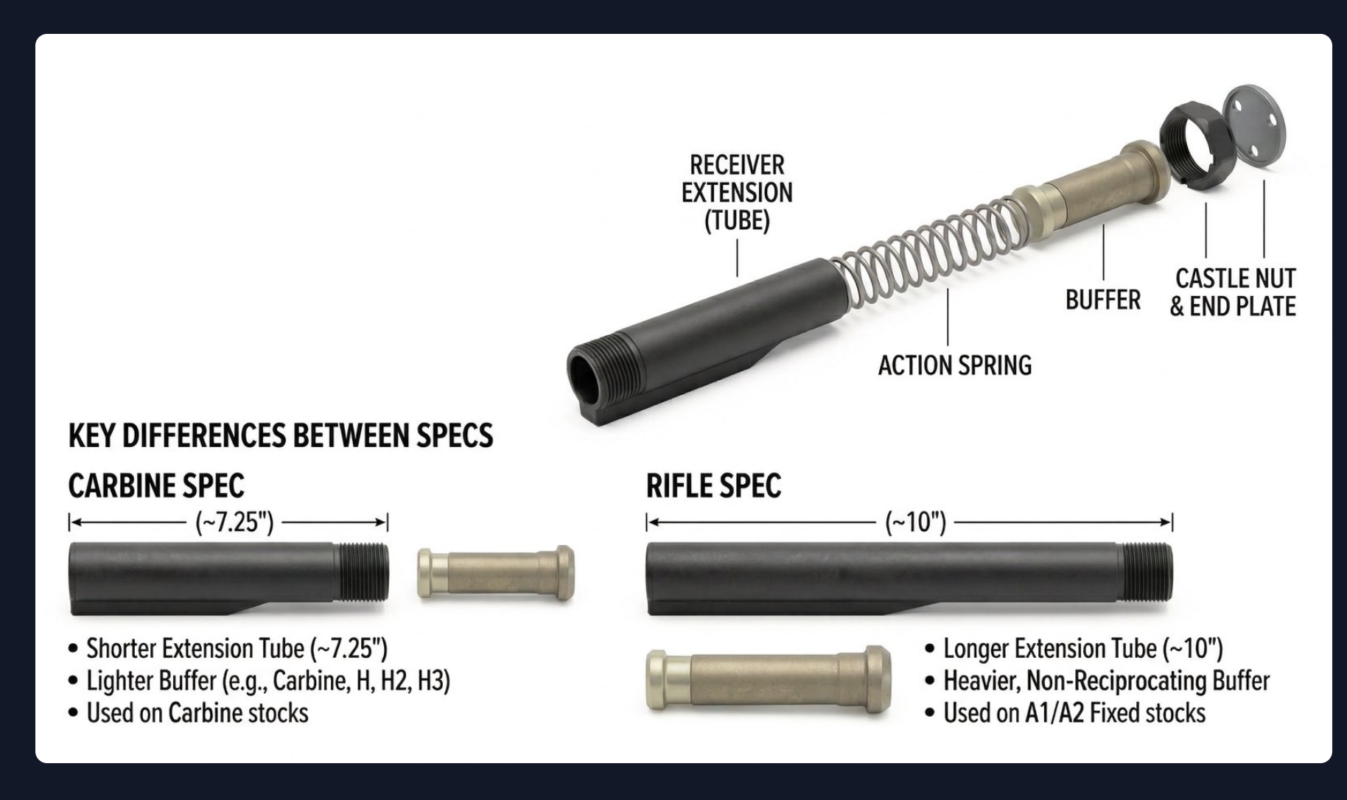
A common misconception treats the buffer as little more than a heavy chunk that sits unused until the gun fires. In truth, the buffer system works as the direct counterpart to the gas system. When a round fires, gas drives the bolt carrier group rearward. The buffer, seated in the receiver extension (commonly called the buffer tube), meets that carrier and compresses the spring behind it. Once the rearward energy is absorbed, the spring expands and drives the carrier forward again to chamber the next round. The buffer itself is a weighted body that adds controlled mass. The tube provides the housing and dictates travel distance. The spring stores and returns energy. Together, these three pieces set the pace of the entire cycle.
A buffer retainer (a small spring-loaded detent, sometimes referred to loosely as a “pin”) keeps the buffer and spring captured in the lower receiver when the upper and lower are separated, though it plays no role in the firing cycle itself. Without a balanced combination of buffer, tube, and spring, the rifle either cycles too violently or fails to complete its stroke. The myth of irrelevance collapses once the system is viewed as active timing control rather than passive bulk.
The Myth That Heavier Buffers Always Soften Recoil
Many believe that simply installing the heaviest buffer available will stretch the recoil impulse and deliver a gentler shoulder feel every time. The truth is more conditional. Heavier buffers require more energy to get moving and, once in motion, they carry that momentum differently than a lighter buffer would. This can produce a slower rearward velocity for the bolt carrier group and a gentler impact against the rear of the tube. The total energy delivered by the gas system stays roughly the same, but a heavier buffer spreads that energy over a slower, longer stroke, so the shoulder may perceive less of a sharp punch. Lighter buffers allow the carrier to race rearward faster, which can produce a snappier feel.
The ideal is the heaviest buffer that still permits full carrier travel and reliable extraction, ejection, and feeding with the ammunition and gas system in use. Excess weight can cause short-stroking, where the carrier fails to travel far enough rearward to pick up a fresh round. Insufficient weight can allow the carrier to cycle so quickly that it outruns the magazine spring, causing feeding failures. Barrel length, gas port diameter, gas system length, suppressor use, bolt carrier weight, and cartridge pressure all influence how much buffer mass a given rifle can handle well. Blindly chasing mass ignores these variables and turns a potential improvement into a reliability problem. Worth noting: the bolt carrier’s own weight matters just as much as the buffer’s. A full-auto-profile carrier (about 11.5 ounces) cycles differently than a lightweight semi-auto carrier (as low as 9 to 9.5 ounces), so buffer choice should account for which carrier is installed.
The Myth of One Universal Buffer Weight in an AR-15 Lower Receiver
Another widespread idea claims that a single buffer weight works for nearly every AR-15. Reality shows clear differences.
Standard carbine buffers weigh about 3 ounces and contain three steel weights. They serve as the baseline for many carbine-length gas systems and work across a broad range of ammunition.
An H (or H1) buffer replaces one steel weight with tungsten and lands around 3.8 ounces. This modest increase often smooths cycling on rifles that feel a bit lively without risking reliability.
H2 buffers step up further with two tungsten weights and reach approximately 4.6 to 4.7 ounces. They see frequent use in short-barreled rifles, pistol builds, and suppressed setups, where the gas impulse is more aggressive.
H3 buffers use three tungsten weights and weigh roughly 5.4 ounces. Larger calibers such as .300 Blackout, .458 SOCOM, or .50 Beowulf often benefit from this extra mass to tame higher pressures.
Rifle-length buffers, designed for the longer A2-style tubes that accompany fixed stocks, weigh approximately 5.2 ounces and are longer overall. Unlike the carbine/H-series buffers, which are built from a stack of individual internal weights, the standard rifle buffer is typically a single solid weight. That’s a construction difference that’s easy to overlook, but it explains why the two families aren’t interchangeable.
These different weights are not interchangeable between carbine and rifle tubes because the physical length and travel distance differ. Treating every build as identical is the myth; matching weight to configuration is the truth.
The Myth That Tubes and Springs Are Interchangeable Afterthoughts
Some shooters assume any tube and spring inside their AR-15 lower receiver will suffice as long as a buffer sits inside. The truth demands precise pairing. Receiver extensions come in two primary lengths. Carbine tubes pair with collapsible stocks and accept carbine buffers and springs. Rifle tubes are longer and require rifle-length buffers and springs for fixed-stock configurations. Mixing the two creates either excessive free travel or a hard impact against the rear of the tube.
Springs themselves vary in free length and coil count. A typical carbine spring measures roughly 10 to 11 inches with around 37 to 39 coils, while rifle springs run longer, commonly cited around 12.25 to 13.25 inches with 41 to 42 coils. Stronger aftermarket springs can further slow the carrier or improve consistency across temperature ranges. The combination of tube length, buffer mass, and spring rate must match the rest of the rifle. A quality mil-spec tube provides a consistent internal diameter and correct threading so the entire assembly seats correctly and stays secure under fire. Viewing tubes and springs as secondary parts overlooks their equal role in controlling the cycle.
The Myth That Buffer Weight Alone Fixes Overgassing
A frequent claim holds that dropping in a heavier buffer in your AR-15 lower receiver will completely cure an overgassed rifle. While added mass helps slow the carrier, gas port size, gas system length, and ammunition pressure remain the primary drivers of how much gas the action sees. Installing a heavier buffer without addressing the root cause may mask symptoms temporarily, yet it leaves excess gas and carbon circulating through the action, which accelerates fouling and parts wear.
Platform specifics matter more than rigid rules. A well-gassed 16-inch mid-length rifle may run cleanly with a standard carbine buffer inside the AR-15 lower receiver, while a suppressed 10.5-inch carbine often prefers something heavier, since suppressors push additional gas and pressure back through the system. Cheap or worn springs can lose tension quickly and introduce the familiar “twang” sound as they vibrate against the tube wall. The myth of a single-part solution fades once the full system (gas port, gas system length, buffer, spring, and carrier) is considered together.
The Truth About Choosing Buffer, Tube, and Spring
Begin by identifying the barrel length, gas system length, and intended ammunition. Note whether a suppressor will be used regularly. For a standard 14.5- or 16-inch carbine or mid-length gas system, a carbine or H1 buffer paired with a quality spring often provides reliable function across common loads. Short-barreled rifles and pistol-length gas systems typically benefit from H2 weight to counteract the sharper gas pulse. Larger-bore cartridges almost always benefit from H3 mass. Configurable buffers that accept interchangeable steel and tungsten weights allow incremental testing without buying multiple complete units.
When in doubt with your AR-15 lower receiver, start with a known reliable combination from a reputable manufacturer and then adjust one variable at a time. Ejection pattern is a useful diagnostic clue: cases landing around the 3 to 4 o’clock position relative to the shooter generally indicate a well-tuned system, while cases thrown far forward (toward 12 to 2 o’clock) suggest excess bolt velocity that a heavier buffer may help calm, and cases dropping straight down or tossed behind the shooter can point to an undergassed system or a weak spring. Reliability across a full magazine, under realistic conditions, remains the ultimate measure. This process replaces guesswork with deliberate matching.
The Myth That Aftermarket Options Are Pure Luxury
Beyond basic weights, several aftermarket solutions inside your AR-15 lower receiver expand the tuning window, yet some dismiss them as unnecessary expense. Braided wire springs, such as those from Geissele, use multiple strands that flex independently to absorb energy and reduce the spring noise often called twang. Flat wire springs from Tubb offer consistent power in a lighter package that resists temperature-related changes in tension. Color-coded Sprinco springs provide graduated rates from reduced to extra power and are rated to maintain load over hundreds of thousands of cycles.
Complete systems such as the VLTOR A5 combine a receiver extension roughly three-quarters of an inch longer than a standard carbine tube, a full-length rifle-style spring, and dedicated multi-weight buffers (ranging from about 3.8 ounces up to nearly 6.8 ounces at the heavy end) to create a smoother stroke with more consistent timing in a package that still fits a collapsible stock. The A5 was originally developed at the Marine Corps’s request to address recoil and reliability concerns with fixed-stock rifles while keeping a collapsible stock’s ergonomics.
Captured spring units and hydraulic buffers further reduce noise and soften the final impact, though they introduce proprietary parts that may limit future interchangeability. These options prove valuable when a traditional setup still feels harsh or inconsistent after basic weight changes. The truth is that quality upgrades serve function rather than fashion when the baseline setup still falls short.
Final Truths on the AR-15 lower Receiver and Buffers, Tubes, and Springs
The buffer, tube, and spring that finish an AR-15 lower receiver far less attention than barrels or triggers, yet they determine whether the rifle cycles cleanly and feels controllable under rapid fire. Myths that equate maximum weight with maximum comfort, or treat buffer choice as a universal formula, overlook the interplay of gas, mass, and spring rate. A thoughtful approach that matches components to the specific barrel, ammunition, and use case produces a rifle that runs reliably while delivering the smoothest possible impulse. Take the time to evaluate the entire system rather than chasing isolated upgrades. The result is a more enjoyable and dependable rifle that performs as intended every time the trigger is pressed.