
NFA, Suppressors
Suppressor 101: What Is a Suppressor and How Does It Actually Work?
Jan
Table of contents

TL;DR- Too Long Didn’t Read
A comprehensive guide on suppressors was published on AR15Discounts.com, detailing their function, performance, and how they impact firearms. This has made choosing the right suppressor less challenging for firearm enthusiasts.
- Suppressors reduce noise and visible flash from the firearm, but not completely.
- They are legal in 42 states with required ATF approval.
- The key components are baffles that slow and cool gases to reduce sound.
- Performance decreases sound by 25-35 decibels in ideal conditions.
- A suppressor does not decrease bullet velocity and can improve accuracy.
- They reduce recoil by 20-30%, aiding in better shot control.
- Suppressor maintenance varies; user-serviceable designs offer easier cleaning.
- Mounting options include direct-thread and quick-detach for convenience.
Suppressors are one of the most popular upgrades for AR-15 owners and other rifle shooters today. They make shooting quieter, more comfortable, and in many cases more accurate. At AR15Discounts.com, we stock a wide range of suppressors for .22 LR, pistols, and rifles, including 5.56, .300 Blackout, 9mm, and .308 platforms. With the $200 tax stamp eliminated as of January 1, 2026, suppressors are more accessible than ever for civilians in the 42 states where they are legal. This article explains what suppressors are, how they work, the real-world performance you can expect, and answers the most common questions shooters ask when considering their first can.
What Is a Suppressor?
A suppressor is a cylindrical device that threads onto the muzzle of a firearm to reduce the sound and visible flash produced when the gun is fired. The term “suppressor” is the technically correct name because it reduces the noise level rather than silencing it completely. The word “silencer” is a popular but less accurate term that was originally used as a marketing name by Hiram Percy Maxim, the inventor of the first commercially successful suppressor in the early 1900s. Today the two terms are used interchangeably, and you will see both on product listings, forums, and even ATF paperwork. They refer to the same piece of equipment.
Suppressors are classified as National Firearms Act (NFA) items, which means they require ATF approval and registration. They are legal for civilian ownership in 42 states but prohibited in California, Delaware, Hawaii, Illinois, Massachusetts, New Jersey, New York, and Rhode Island. Always verify your local laws before purchasing.
How Does a Suppressor Actually Work?
When a cartridge is fired, three main sources of sound are created: the muzzle blast (high-pressure gas escaping the barrel), the sonic crack (bullet breaking the sound barrier), and mechanical action noise (slide or bolt cycling). A suppressor is a muzzle device that primarily targets the muzzle blast, which is the loudest component in most cases.
Inside the suppressor is a series of baffles—internal chambers separated by metal plates or cones. As hot, high-pressure gas leaves the barrel and enters the suppressor, it expands into these chambers. Each baffle slows and cools the gas, forcing it to take a longer path before exiting the front of the can. This expansion and cooling process reduces the pressure and temperature of the gas, which lowers the intensity of the sound wave that reaches the shooter and bystanders.
Most modern suppressors use a combination of baffle shapes (K-baffles, monocore, or hybrid) to optimize gas trapping while keeping weight and length reasonable. Some designs also incorporate wipe material or ablative media, especially older or specialized models, to further slow gas, but these require replacement after use. The suppressor does not stop the bullet, so the sonic crack from supersonic ammunition remains. Subsonic ammunition eliminates this crack, allowing for much quieter shooting.
Realistic Performance and What to Expect
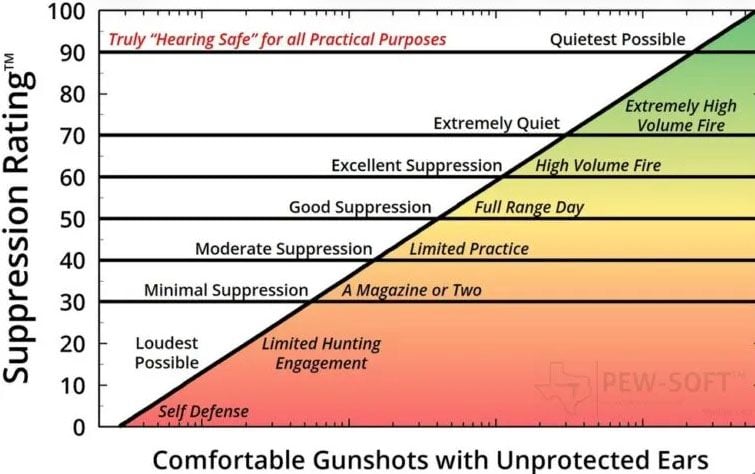
Suppressors do not make firearms completely silent. They reduce the muzzle blast portion of the sound, often by 25 to 35 decibels depending on the caliber, barrel length, ammunition, and suppressor design. A typical unsuppressed 5.56 AR-15 shot at the muzzle is around 165 decibels. A good suppressor can bring that down to 130 to 140 decibels at the shooter’s ear. This is still loud enough to require hearing protection for extended shooting, but it is significantly safer and far less painful than unsuppressed fire.
Subsonic .300 Blackout or .22 LR with a suppressor can reach hearing-safe levels below 140 dB for short sessions, but even then, ear protection is recommended for long-term hearing health.
A suppressor does not reduce velocity. The bullet exits the barrel before the gas is trapped, so muzzle velocity remains unchanged. Many shooters report a slight improvement in accuracy because the suppressor stabilizes the muzzle and reduces recoil, making follow-up shots easier to control. Some suppressors can cause a small point-of-impact shift, usually one to two MOA, but high-quality models with good alignment minimize this. Proper mounting and consistent torque are key to maintaining accuracy.
Backpressure is the additional gas pressure that builds inside and pushes back into the firearm’s action. In direct-impingement AR-15s, this can increase gas blowback through the charging handle and ejection port, leading to more fouling, faster cycling, and gas in the shooter’s face. Blowback-operated PCCs and some pistols are especially sensitive to this.

Traditional baffle suppressors create higher backpressure for better sound reduction, while flow-through designs, such as those used in the HUXWRX Flow series, vent gas forward to reduce backpressure significantly. This results in cleaner, more comfortable shooting. Backpressure is one of the most important factors to research when choosing a suppressor for a semi-auto AR-15.
Caliber Compatibility and Maintenance
Many suppressors are multi-caliber. A 30-caliber suppressor can safely be used on 5.56, .300 Blackout, and .308 rifles as long as the thread pattern matches and the suppressor is rated for the pressure. Dedicated 9mm suppressors are typically limited to 9mm and smaller calibers, though some can handle subsonic .300 Blackout. Always check the manufacturer’s specifications for caliber ratings and barrel length restrictions.
Maintenance depends on the design. Sealed ones are low-maintenance and can run thousands of rounds without cleaning. User-serviceable suppressors allow you to disassemble and clean carbon buildup, which is especially helpful if you shoot frequently or use dirty ammunition. Cleaning intervals vary, but many shooters clean between 1,000 and 3,000 rounds. Always follow the manufacturer’s instructions to avoid damage.
Mounting Options and Recoil Reduction
Direct-thread mounts screw the suppressor directly onto the barrel threads. They are simple, lightweight, and secure but usually require tools for installation and removal.
Quick-detach mounts use a locking mechanism, often a ratchet or cam system, that allows fast attachment and removal without tools. QD mounts are convenient for switching between hosts but add a small amount of weight and length.
Suppressors also reduce felt recoil, typically by 20 to 30 percent. By trapping and slowing expanding gas, they decrease rearward force on the firearm. This makes follow-up shots faster and easier to control, particularly on AR-15 rifles and pistols.
Why Choose AR15Discounts.com?
We offer competitive pricing, fast shipping to your SOT dealer, and expert support to help you select the right suppressor for your pistol, PCC, or rifle. Browse our suppressor collection today and elevate your shooting experience.
There is no functional difference. “Suppressor” is the technically correct term because the device reduces sound rather than eliminating it. “Silencer” is a historical marketing term that dates back to the early 1900s. Today, both terms are used interchangeably and refer to the same item, including in ATF paperwork.
A suppressor traps and slows the high-pressure gas that exits the barrel when a firearm is fired. Inside the suppressor, a series of internal baffles forces the gas to expand, cool, and take a longer path before exiting the muzzle. This reduces the intensity of the muzzle blast, which is the loudest part of a gunshot.
No. Suppressors significantly reduce sound, but they do not make firearms silent. Supersonic ammunition still produces a sonic crack, and most suppressed firearms remain loud enough to require hearing protection. Subsonic ammunition is much quieter, but even then, complete silence is a myth.
Yes, suppressors are legal for civilian ownership in most U.S. states. They are prohibited in a small number of states, so buyers must always verify state and local laws. Suppressors remain regulated items and require approval and registration through the appropriate federal process.
A suppressor does not reduce bullet velocity. The projectile exits the barrel before the gas is trapped. Many shooters experience improved practical accuracy due to reduced recoil and muzzle movement. Some suppressors cause a minor point-of-impact shift, but this is typically consistent and correctable with proper zeroing.
Backpressure is excess gas that is pushed back into the firearm’s action when a suppressor restricts gas flow. On AR-15s, this can lead to faster cycling, increased fouling, more gas blowback toward the shooter’s face, and added wear. Flow-through suppressor designs reduce backpressure, while traditional baffle designs usually offer better sound suppression with more gas return.
Often, yes. Many suppressors are rated for multiple calibers. For example, a 30-caliber suppressor can typically be used on 5.56, .300 Blackout, and .308 rifles if it is rated for those pressures and barrel lengths. Always confirm manufacturer specifications before using a suppressor on a different caliber.
It depends on the design. Sealed suppressors require little maintenance and can run thousands of rounds without cleaning. User-serviceable suppressors can be disassembled and cleaned, which is beneficial for high round counts or dirty ammunition. Cleaning intervals vary by model and usage, so manufacturer guidance should always be followed.
Direct-thread suppressors screw directly onto the barrel and are lightweight and simple but slower to remove. QD mounts use a locking mechanism that allows quick attachment and removal without tools. QD systems are more convenient for switching between firearms but add some weight and length.
Yes. Suppressors typically reduce felt recoil by about 20 to 30 percent. By slowing and redirecting expanding gas, they reduce rearward force and muzzle rise, making firearms easier to control and follow-up shots faster, especially on semi-automatic rifles like the AR-15.