
Aero Precision, AR Rifle
Aero Precision .308 Upper – Stepping Beyond the 5.56 Platform
Jan
Table of contents

TL;DR- Too Long Didn’t Read
The blog discusses the differences between 5.56 NATO and .308 Winchester, highlighting the Aero Precision .308 upper for building reliable large-frame AR rifles. It explores the advantages of each cartridge and the practicality of using Aero Precision components for building a .308 AR.
- The 5.56 NATO is lightweight, offers low recoil, and suits home-defense and moderate-range shooting.
- The .308 Winchester delivers greater power, range, and penetration, ideal for hunting and precision shooting.
- Building a .308 AR is complex due to lack of standardization, but Aero Precision provides consistency with its M5 uppers.
- Aero Precision’s M5 platform supports smooth operation and offers strong accuracy potential.
- Aero’s components and matched sets simplify the assembly process for builders new to .308 ARs.
The Aero Precision .308 upper serves as an excellent entry point into the realm of large-frame AR rifles, especially for shooters ready to expand beyond the familiar confines of the 5.56 NATO platform. While the 5.56 AR-15 handles a wide array of tasks effectively, it begins to show clear limitations when situations demand greater power, deeper penetration, and extended range. Exploring the practical differences between 5.56 NATO and .308 Winchester (7.62×51 NATO) helps clarify why adding a .308 rifle becomes a natural and often necessary progression for serious shooters seeking a more versatile and capable setup.

5.56 NATO vs. .308 Winchester
Strengths, Limitations, and Ideal Applications
The 5.56 NATO, along with its close civilian counterpart .223 Remington, prioritizes lightweight rifle configurations and high muzzle velocity for engagements at moderate distances. It performs exceptionally well in home-defense roles, where manageable recoil allows rapid follow-up shots and certain defensive loads can reduce over-penetration risks. Its relatively low recoil also makes it highly approachable for new shooters and well-suited for extended training sessions.
From a recreational and practical standpoint, 5.56 remains a favorite for range use and high-volume shooting due to lower ammunition costs and reduced shooter fatigue. The cartridge also excels in varmint and predator control, where its flat trajectory and quick handling characteristics allow accurate shooting out to approximately 400–500 yards under favorable conditions. Typical 55- to 62-grain loads generate roughly 1,200 to 1,300 foot-pounds of muzzle energy. However, as distance increases beyond 500–600 yards, retained energy drops rapidly, wind drift becomes more pronounced, and terminal performance becomes less predictable.
Recoil with 5.56 remains modest, often around 7 foot-pounds in an 8-pound rifle, contributing to its reputation as a controllable and forgiving cartridge. These characteristics explain why the 5.56 AR-15 remains one of the most popular rifle platforms in the world.
Despite its many advantages, the 5.56 NATO has clear limitations. When scenarios require reliable penetration through thick brush, intermediate barriers, or heavy bone, the cartridge often lacks the mass and retained energy needed for consistent results. Ethical hunting considerations further restrict its use on larger game animals such as deer, hogs, or elk beyond relatively short distances. Wind sensitivity also increases dramatically at longer ranges, making precise shot placement more challenging.
By comparison, the .308 Winchester delivers a substantial leap in performance. Depending on the specific load, muzzle energy commonly falls between 2,500 and 3,000 foot-pounds, more than double that of 5.56. Typical 150- to 168-grain projectiles retain over 1,000 foot-pounds of energy well past 500 yards, supporting practical use out to 800 yards or more in hunting and precision shooting roles.
The .308 excels at barrier penetration and provides consistent terminal performance on larger game animals. Its versatility is further enhanced by a broad selection of bullet weights and constructions, ranging from lightweight hunting loads to match-grade projectiles optimized for accuracy. Bonded and controlled-expansion bullets offer dependable performance across a variety of environments and target types.
These gains do come with tradeoffs. Recoil increases to approximately 20 foot-pounds, and rifles chambered in .308 are typically heavier than their 5.56 counterparts. However, these compromises are often considered worthwhile in demanding scenarios such as hog hunting through dense terrain, engaging deer at distances beyond 300–400 yards, or ringing steel at extended ranges. Where the 5.56 begins to lose effectiveness, the .308 continues to deliver authoritative performance.
This contrast highlights the complementary roles of both cartridges. The 5.56 thrives in lightweight, fast-handling rifles designed for speed, efficiency, and high round counts, while the .308 becomes indispensable when raw power, extended range, and adaptability take precedence. For shooters whose interests extend beyond casual plinking or short-range defense, the .308 fills critical gaps that the smaller cartridge simply cannot.

The Unique Challenges of Building a .308 AR
Assembling a 5.56 AR-15 is relatively straightforward due to decades of military adoption and civilian refinement. Industry standardization has made receivers, barrels, handguards, and internal components largely interchangeable across manufacturers, allowing builders to mix and match parts with minimal concern.
The .308 AR platform, often referred to as AR-10 or LR-308, operates under a different set of rules. Unlike the AR-15, no true universal standard governs large-frame ARs. The two dominant patterns are the original ArmaLite AR-10 design and the more common DPMS Gen 1 (high-profile) pattern. Attempting to combine components from these patterns frequently results in fitment and compatibility issues.
Bolt carrier groups, barrel extensions, handguard heights, takedown pins, and buffer systems can vary significantly between patterns. These inconsistencies can lead to unreliable cycling, headspacing problems, excessive wear, or complete malfunctions. For builders unfamiliar with the nuances of large-frame ARs, this complexity can turn a .308 project into a frustrating and expensive experience.
Why Aero Precision M5 Uppers Simplify the Process
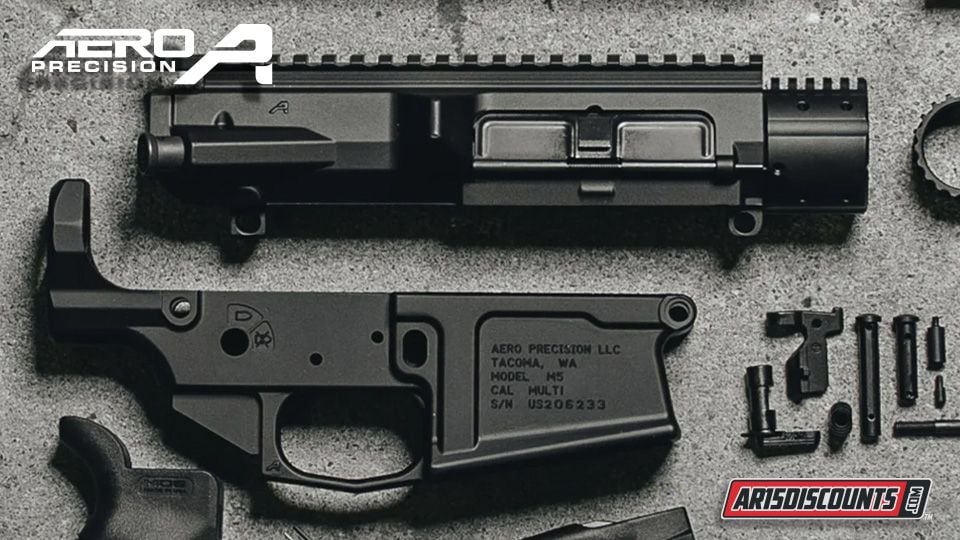
This lack of standardization is precisely why Aero Precision’s M5 platform has become so popular among first-time .308 builders. Aero commits fully to the DPMS Gen 1 high-profile pattern, ensuring consistency and compatibility across its entire M5 lineup.
An Aero Precision .308 upper, particularly in complete form, arrives fully assembled with a nitride bolt carrier group, charging handle, and high-quality barrel. Aero commonly uses 4150 CMV steel barrels finished with QPQ nitride treatment, providing excellent resistance to heat, wear, and corrosion. These uppers pair seamlessly with Aero’s ATLAS handguards, which feature slim, lightweight M-LOK designs and maintain proper height alignment for the DPMS pattern.
Gas systems are tuned to provide smooth operation and manageable recoil, contributing to both reliability and shooter comfort. Accuracy potential is strong, with many shooters reporting sub-MOA performance when using quality match ammunition.
For those new to large-frame ARs, selecting a complete Aero Precision .308 upper or a matched M5 builder set removes much of the uncertainty associated with component compatibility. Tight manufacturing tolerances and Aero’s precision-focused approach deliver dependable performance at a price point that remains accessible compared to many other large-frame AR options.
Real-world results reinforce this reputation. Shooters routinely report clean, ethical hog harvests inside 300 yards using 150- to 168-grain loads, consistent hits on steel targets at 800 yards, and reliable suppressed operation without excessive tuning. These outcomes reflect a platform designed to work as a cohesive system rather than a collection of mismatched parts.
A Practical Starting Configuration
For shooters planning their first .308 rifle, a 20-inch rifle-length Aero Precision .308 upper paired with an ATLAS S-ONE handguard offers an excellent balance of velocity, recoil management, and long-range capability. When combined with a matching M5 lower receiver or builder set, this configuration eliminates common compatibility pitfalls while delivering proven big-bore performance.
This straightforward approach allows shooters to focus on shooting rather than troubleshooting. Once the rifle is put through its paces, the value of a properly built .308 AR becomes immediately apparent. While the 5.56 continues to serve important roles, the .308 adds a level of power and reach that completes a comprehensive and capable rifle collection.