
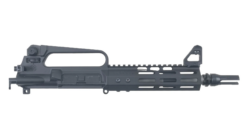
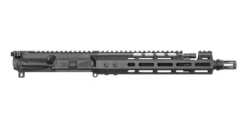
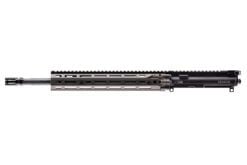
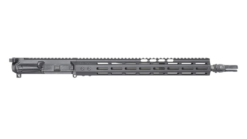
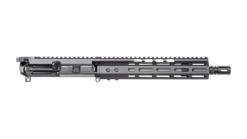
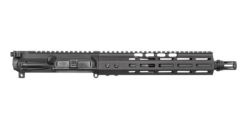
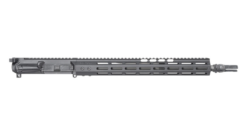
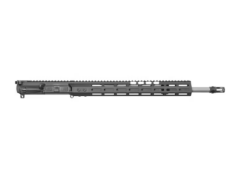
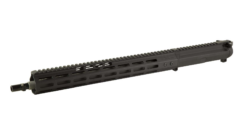
Pair a complete upper with a compatible complete lower and, in most cases, the rifle is essentially ready to go once the two halves are joined with the pivot and takedown pins. There is no need to install the barrel, gas system, trigger, buffer assembly, or other major components yourself. That simplicity is one of the biggest advantages of buying complete upper and lower assemblies separately.
At AR15Discounts, you will find complete AR-15 uppers from brands including NBS, Dirty Bird Industries, One Horse, Geissele, Daniel Defense, LMT, Noveske, and others. That selection makes it easier to choose an upper based on barrel length, caliber, intended use, features, and budget without having to source every component separately.
Buying a Complete Upper Versus Building One Yourself
Building an AR-15 upper from individual components gives you maximum control over the final configuration, but it also requires more tools, time, and familiarity with the platform. Depending on the build, proper assembly can require a bench vise, upper receiver fixture or reaction rod, torque wrench, punches, barrel-nut tools, and an understanding of gas-system alignment and component tolerances.
A complete upper removes much of that assembly work. The barrel, gas system, handguard, and receiver arrive installed as a complete unit, allowing most shooters to attach the upper to a compatible lower receiver with little more than the front and rear takedown pins. If the upper includes a bolt carrier group, the manufacturer may also have verified the complete assembly before it left the factory. If the BCG is sold separately, shooters should still follow the manufacturer’s recommendations regarding compatibility and inspection.
For first-time builders, shooters who do not want to invest in specialized assembly tools, or anyone who simply wants to get a rifle running quickly, a complete upper can be the most straightforward option.
What Makes a Good AR-15 Complete Upper?
The barrel is one of the most important components in any complete upper because it has a major influence on accuracy, durability, velocity, and overall handling. Common barrel materials include 4150 chrome-moly vanadium steel and 416R stainless steel, with finishes or treatments such as nitride or chrome lining used to improve wear and corrosion resistance.
For general-purpose rifles, a 16-inch barrel remains one of the most popular choices because it provides a good balance of velocity, handling, and legal simplicity for a conventional rifle configuration. Mid-length gas systems are also common on 14.5- and 16-inch barrels and are popular because they can provide a smoother recoil impulse and less abrupt cycling than a comparable carbine-length setup when the rest of the gas system is properly balanced.
Shorter barrels, such as 10.3-, 10.5-, or 11.5-inch configurations, prioritize compact handling, while 18- and 20-inch barrels provide additional velocity and are often selected for precision-oriented, competition, hunting, or traditional rifle builds.
Twist rate is another consideration. A 1:7 or 1:8 twist is common on modern 5.56 NATO and .223 Remington barrels and works with a broad range of commonly available ammunition. Shooters planning to use a specific bullet weight or specialized load should check the barrel manufacturer’s recommendations.
Gas Systems, Bolt Carrier Groups, and Handguards
A properly balanced gas system plays a major role in reliability and how smoothly the rifle cycles. Barrel length, gas-system length, gas-port sizing, ammunition, suppressor use, buffer weight, and spring rate can all affect performance. There is no single gas-system configuration that is ideal for every rifle, but quality complete uppers are designed around a combination of components intended to work together.
When a bolt carrier group is included, look for features such as a properly staked gas key, quality bolt steel, and appropriate inspection or testing procedures from the manufacturer. Full-mass or M16-profile carriers are common in modern AR-15 builds and provide a proven baseline for reliable operation.
Free-float M-LOK handguards are also common on current complete uppers. Because the handguard does not contact the barrel directly, accessories and shooting pressure placed on the rail have less influence on barrel harmonics than with older non-free-float designs. M-LOK also provides plenty of mounting space for lights, grips, bipods, sling hardware, and other accessories without requiring unnecessary rail sections.
Forged 7075-T6 aluminum upper receivers with Type III hard-coat anodizing remain one of the most common and proven receiver configurations available.
Complete Uppers for Different Types of Builds
One of the biggest advantages of shopping for a complete upper is the variety of configurations available. Budget-oriented uppers make it possible to finish a dependable range rifle without spending heavily on premium components, while higher-end offerings can feature cold-hammer-forged barrels, premium bolt carrier groups, rigid handguard systems, enhanced coatings, or proprietary receiver designs.
NBS and Dirty Bird Industries offer options aimed at shooters looking for practical AR-15 configurations across a range of budgets. Brands such as Geissele and Daniel Defense are commonly associated with premium barrels, rails, and duty-oriented components, while LMT offers distinctive monolithic receiver systems and removable-barrel designs. Noveske is well known for premium AR barrels and high-end rifle components.
The right choice depends less on the logo on the receiver and more on how the upper will actually be used. A lightweight range rifle, suppressed defensive build, precision setup, hunting rifle, and general-purpose carbine can all benefit from different combinations of barrel length, gas system, handguard, and barrel profile.
Find the Right Complete Upper for Your AR-15
A complete upper removes many of the variables involved in assembling an AR-15 from individual components while still giving you plenty of control over caliber, barrel length, handguard style, and overall performance.
Use the filters below to narrow the selection by caliber, barrel length, brand, and other features, then match your upper with a compatible lower receiver and the components required for your intended configuration.
Frequently Asked Questions
Does a complete upper include the bolt carrier group and charging handle?
Sometimes. Many complete uppers include both the bolt carrier group and charging handle, while others are sold without one or both components. Always check the individual product listing before ordering.
Will any complete AR-15 upper fit my existing lower?
Most standard AR-15 uppers are designed to fit standard-pattern AR-15 lower receivers using the front pivot pin and rear takedown pin. However, proprietary receiver sets and large-frame AR platforms can use different dimensions. You should also confirm that the caliber and lower-receiver components are appropriate for the upper you select.
What barrel length should I choose?
A 16-inch barrel is one of the most versatile choices for a general-purpose AR-15. Shorter barrels provide a more compact package, while longer barrels can provide additional velocity and may be preferred for hunting, competition, or precision shooting. The best choice depends on how the rifle will be configured and used.
Do I need special tools to install a complete upper?
Normally, no specialized gunsmithing tools are required to attach a complete upper to a compatible lower receiver. The upper is installed using the rifle’s front pivot pin and rear takedown pin. Additional tools may be required if you plan to change muzzle devices, handguards, gas-system components, or other parts.
Can I use a suppressor with a complete upper?
Many complete uppers can be used with suppressors as long as the suppressor, muzzle device, caliber, barrel, and firearm configuration are compatible. Suppressors can change the amount of gas and bolt velocity in the operating system, so some rifles may benefit from changes to the gas system, buffer system, or other components.
How important is barrel twist rate?
Twist rate determines how quickly the rifling rotates the bullet and can affect stability with different projectile lengths and weights. For 5.56 NATO and .223 Remington, 1:7 and 1:8 twist rates are common because they work well with a broad range of commonly available ammunition.
Is a complete AR-15 upper considered a firearm?
Under current federal regulations, the lower receiver is the regulated receiver on AR-15/M16-pattern firearms rather than the complete upper receiver. State and local laws may differ. Once an upper is installed on a lower, the complete firearm must comply with all applicable federal, state, and local requirements, including rules governing short-barreled rifles and other regulated configurations.